




























How to Set Up Business in Japan Model Case Commentary: Business Setup
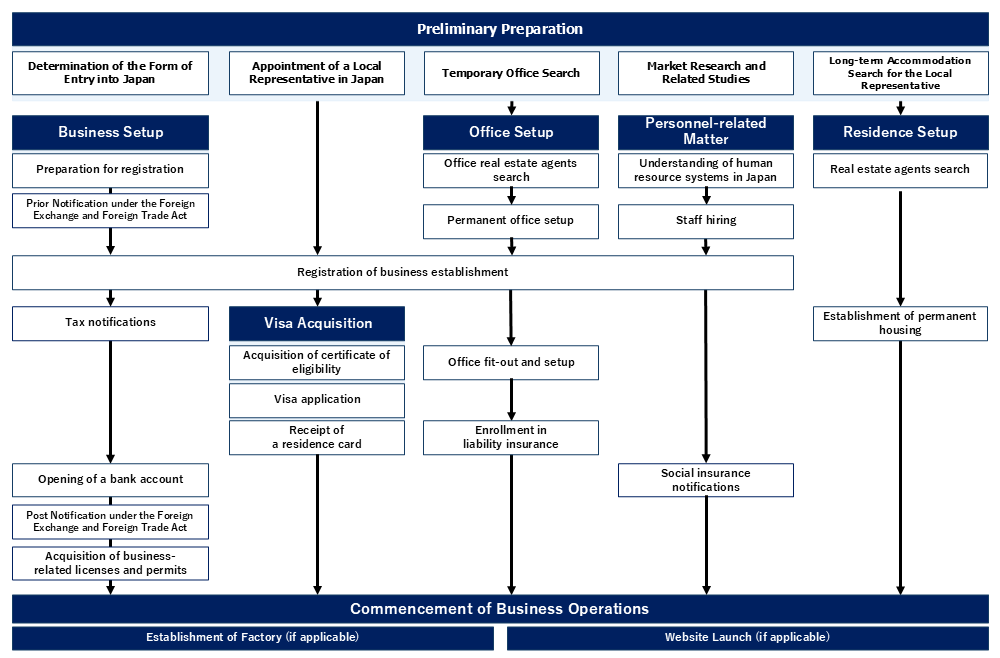
1. Preliminary Preparation
(1) Determination of the Form of Entry into Japan
Companies should determine the most appropriate form of entry based on their intended business activities in Japan.
(2) Appointment of a Local Representative in Japan
Foreign companies generally establish a business presence in Japan in one of three modes.
- Representative office
Representative offices are established as locations for carrying out preparatory and supplemental tasks aimed at enabling foreign companies to engage in full-scale business operations in Japan. These offices may conduct market surveys, collect information, purchase goods, and implement publicity/advertising efforts, but they are not permitted to engage in sales activities. The establishment of representative offices does not require registration. A representative office cannot ordinarily open bank accounts or lease real estate in its own name, so agreements for such purposes must instead be signed by the head office of the foreign company or the representative at the representative office in an individual capacity. - Branch office
Foreign companies wishing to engage in continuous transactions in Japan must register in the country (see Article 818 of the Companies Act). To do so, they must at least register (1) the appointment of a representative in Japan, (2) the establishment of a branch office, (3) a Japanese corporation, or (4) a partnership. Of these, the simplest means for a foreign company to establish a base for business operations in Japan is to set up a branch office. The branch office can begin business operations as soon as an office location is secured, the branch office representative determined, and the necessary information registered. A Japanese branch office is a business location that provides services in Japan decided upon by an organization authorized by the foreign company, and ordinarily is not expected to engage in independent decision making. A branch office does not have its own legal corporate status, but instead is deemed to be encompassed within the corporate status of the foreign company. In general, therefore, the foreign company is ultimately responsible for all debts and credits generated by the activities of its Japanese branch office. A Japanese branch office, however, may open bank accounts and lease real estate in its own name. - Subsidiary company
A foreign company establishing a subsidiary company in Japan must choose to establish the subsidiary company as a joint-stock corporation (Kabushiki-Kaisha (K.K.)), limited liability company (Godo-Kaisha), or similar entity stipulated by Japan’s Companies Act. Both unlimited partnerships (Gomei-Kaisha) and limited partnerships (Goshi-Kaisha) are granted corporate status under the Companies Act, but they are rarely chosen in practice because equity participants bear unlimited rather than limited liability. All types of subsidiary companies can be established by completing the required procedures stipulated by law and then registering the corporation. A subsidiary is a separate corporation from the foreign company, so the foreign company will bear the liability of an equity participant stipulated by law for all debts and credits generated by the activities of the subsidiary. Other methods by which a foreign company may invest in Japan using a Japanese corporation but without establishing a subsidiary are by establishing a joint venture with a Japanese enterprise or investment company, and by equity participation in a Japanese enterprise.
Joint-stock corporations and limited liability companies are similar insofar as liability in them is limited to the assets contributed by equity participants. Compared with joint-stock corporations, however, limited liability companies have greater freedom of self-government through their articles of association and, unlike joint-stock corporations, they may stipulate the procedures for preparing and approving their financial statements in their articles of association as there are no laws and regulations relating to finalizing annual financial statements and do not have to publish their financial results. Additionally, although their members are as a rule required to execute business, their articles of association may allow for the appointment of “managing partners.”
(3) Temporary Office Search
When setting up a business entity in Japan, you will need to complete various work and meet with numerous people. It is therefore advisable to rent a temporary office for approximately three months that has basic office equipment, such as a fax and telephone.
For temporary office rental, it is advisable to choose the JETRO Invest Japan Business Support Center (IBSC), offices provided by local and regional governments, or private companies based on availability, requirements and the cost.
The offices provided by private companies require thousands of dollars in rental fees and security deposits (security deposits are usually refunded, minus deductions agreed on in the contract, at the end of the lease period). Such facilities typically offer a full range of secretarial and business services which are charged on a services-rendered basis.
Some local and regional governments offer discounted or free temporary office spaces. Another option is to utilize free temporary office space (for a maximum of 50 business days) provided by the JETRO Invest Japan Business Support Center (IBSC). Located in six major business areas across Japan, IBSCs provide not only free temporary office space, but also offers consultations with industry experts and accountants, use of meeting rooms and exhibition halls, and access to a wealth of business and trade resources. A typical one-person private IBSC office is 10 square meters (there are also 12 and 16 square meter configurations). IBSC has well-established basic business services such as a telephone, facsimile and copy machine (charged on a services-rendered basis). The greatest benefit of utilizing the IBSC is the generous support offered by IBSC staff and veteran advisors, in everything from tax and labor issues, to visas and general incorporation procedures."
(4) Market Research and Related Studies
When preparing to enter the Japanese market, it is essential to gather as much information as possible on the competitive environment for your company's products or services.
Such information can be obtained through organizations like JETRO as well as International accounting and consulting firms.
(5) Long-term Accommodation Search for the Local Representative
After formulating a basic schedule for your company's expansion into Japan, the person appointed to represent the firm in Japan will need to reside in Japan on a semi- long-term basis to begin start-up procedures (unless the representative already resides in Japan). Details of such procedures, which typically take about three months to complete, are explained in another section. During this period, your representative will need accommodations in Japan. Most elect to stay in hotels offering weekly or monthly rates or monthly-contact apartments (called "monthly mansions" in Japan).
There are several important factors to consider when renting a monthly apartment for such a long-term stay. This may include proximity to train and subway stations as well as English speaking services. Rates vary greatly according to the availability of facilities, location and other factors."
2. Business Setup
Foreign companies establishing a business entity in Japan can choose from three basic types of operations: 1) subsidiary company ("kabushiki kaisha"), 2) branch (of foreign office) and 3) representative office.
As the procedures for setting up a company or a branch in Japan are complicated and must be conducted in Japanese, most people enlist the services of a professional, such as an attorney-at-law, judicial scrivener, or administrative scrivener to handle establishment procedures which typically take three months to complete.
(1) Preparation for registration
Preparation
The following preparations should be completed before commencing set-up procedures:
-
1.
Deliberation of business objectives
Companies in Japan are only allowed to carry out business activities written in the "objectives" section of the firm's "articles of incorporation". Thus, it is vital to thoroughly research the feasibility and scope of your company's "objectives" or business activities before starting the incorporation procedures.
-
2.
Determination of Trade name
A trade name must be included in the articles of incorporation and be registered. The trade name must be expressed in Japanese characters (hiragana, katakana and kanji) or letters of the alphabet. An injunction may be filed after incorporation if the mistakable trade name that seems similar with another company is used for dishonest purpose. Prior to registration, a proper research whether another company has already used it should be conducted to determine a trade name.
-
3.
Permits
Some business activities require that the company obtain special permission from (or submit special notification to) relevant government or municipal offices once the business has been established and trading has commenced. It is recommended to check beforehand whether or not your company will need to obtain such permissions or submit such notifications.
-
4.
Reports and notification under the Foreign Exchange and Foreign Trade Control Law
Companies are generally required to file notification with the Bank of Japan (BOJ) within 45 days of from the date of establishment. (Where prior notification is required, notification must be filed from six months prior to engagement in transactions or other activities and allowing sufficient time for examination.). The BOJ provides guidance on the requirements for this procedure, but many companies choose to consult with a professional in the field to make this report.
-
5.
Personal name seal
People who assume important posts within the company will need to have a personal name seal (or "jitsuin") made and registered with the local government office in the municipality in which he or she resides. These personal seals are generally used in Japan in the same manner as signatures are in other countries, i.e., as a form of identification. Your "jitsuin", which can be made at a seal store for as little as 5,000 JPY, must be registered prior to registering the company. Over the course of the company establishment process you will need several copies of the certificate of seal impression from your local government office. Please note that a residence card must be possessed in order to obtain the certificate of seal impression.
-
6.
Company seals
Once you have decided on your company name, the next step is to make company seals. Typically, a set of three seals is made: a Representative Seal (known as "daihyoin", which is basically the "jitsuin" for the company), a Bank Seal (known as "ginkoin"), and a Company Name Seal (known as "kakuin"). A set of seals can be made at a specialized seal shop for as little as 10,000 JPY. The "daihyoin" is the seal to be registered in the competent legal affairs bureau by the company's representative and can be used as the representative's personal seal (in his or her capacity as representative). In most cases, however, the representative uses separate seals for personal and company business. The "ginkoin" is used in the company's dealing with banks, while the "kakuin" is a square stamp used when issuing receipts, invoices and the like. The stamp is usually affixed so that it slightly overlaps with the company name printed on the paper.
-
7.
Deciding on a bank for capital
When incorporating a joint-stock corporation by offering (boshû-setsuritsu), the company's paid-in capital must be deposited in a bank. The company must obtain a certificate of deposit of paid-in capital issued by the bank, which is then submitted to the competent legal affairs bureau when applying for registration. Due to the variances in the deposit fee depending on the bank, it is necessary to investigate such fees prior to setup.
When a company is incorporated without offering (hokki-setsuritsu), it is also possible to deposit the company's paid-in capital in the account of the initiator, the representative director at the time of incorporation, or a director at the time of incorporation. In this case, a copy of a bankbook (or a bank statement of account) and a document that certifies deposit of paid-in capital must be submitted to the competent legal affairs bureau. When all of the initiator, the representative director at the time of incorporation, and directors at the time of incorporation have their domicile overseas, it is possible to delegate receipt of deposit to a third party. A power of attorney, a copy of a bankbook whose account holder is the third party, and a document that certifies the deposit of paid-in capital must be submitted. Domestic headquarters and branches, and overseas branches of Japanese banks, and branches of foreign banks in Japan can be used as the payment handling bank.
Company registration
-
1.
Subsidiary company
Once the above preparations have been completed, it is time to register the company. In the case of a corporation, registration costs start at about 250,000 JPY. This amount does not include the aforementioned name seal expenses and fees charged by the bank for paid-in capital, as well as service fees charged by any professionals hired (which usually run between 200,000 JPY and 500,000 JPY).
-
2.
Branch
Unlike a company, setting up a branch does not require you to draw up new articles of incorporation. Instead, you prepare an affidavit for certification by your country' s Embassy in Japan. If your country' s embassy does not provide notary services, certification by a public notary in your home country is acceptable.
Expenses start at approximately 100,000 JPY; name seal expenses and services fees paid to professionals, however, still apply. There are basically no differences between the rules and restrictions that apply to the business activities of companies and those that apply to branches.
-
3.
Representative office
Establishing a representative office is a very effective method of setting up a business when the company is still at the advertising or market research stage of its expansion into Japan. While a representative office cannot perform actual business activities, it generally does not have to be registered, and so registration costs do not apply and tax notices do not need to be submitted. To engage in business activities, a representative office only needs to be registered as a subsidiary or branch as described above.
Professionals
Japan has many licensed professionals with publicly administered qualifications in a broad range of areas (legal professional business). As a rule, the scope of business of licensed professionals are defined by competent ministries and agencies, and it is not permitted by law that any unlicensed person acts as an attorney-in-fact or agent in any business exclusive to the professional of other license on behalf of a company or other organizations.
In addition, recently, administrative procedures have been increasingly digitalized, and therefore it is possible for licensed professionals to take electronic procedures in the scope of their business. Professionals in Japan are only qualified to provide a defined range of services, so you will most likely need different professionals for different tasks. Many offices of professionals are often in alliance with offices of other kind of professionals, or they provide referral to appropriate professionals.
-
1.
Attorney-at-law
The main service offered by an attorney-at-law is to act on behalf of his or her client in legal matters, either by a request from the client or by court order. In Japan, many people consult a lawyer after a legal problem has arisen. However, it is important to retain a consulting attorney-at-law so as to receive legal advice whenever necessary, and to prevent legal problems from initially occurring.
-
2.
Judicial scrivener
The main services offered by a judicial scrivener include acting as an Attorney-in-Fact for application for official registration of companies, corporate bodies, or real estate, providing related advice, and preparation of documents relating thereto. If you are involved with companies and corporate bodies as a whole, real estate, financial institutions, or fund providers, your need for a judicial scrivener will be greater.
-
3.
Administrative scrivener
The main services offered by an administrative scrivener involve submitting the applications and notifications to the government and other administrative institutions. Many people also engage administrative scriveners to apply for their certificates of eligibility, permission for changing status of residence, or extension of period of stay, etc.
-
4.
Certified public accountant
The main services offered by a certified public accountant (CPA) involve the performance of financial statement audits, certification, and consulting.
In Japan, only a CPA can audit, prepare an auditor's reports, and write an opinion of the audit.
-
5.
Tax accountant
Tax accountants offer services such as bookkeeping, preparing financial statements, submitting necessary tax notices, filing returns, general tax-related consulting, and other services related to accounting and tax.
-
6.
Labor and social security attorney
The main services offered by a labor and social security attorney include all labor, social insurance and labor standards-related procedures as well as consultation on aspects pertaining to labor management and labor disputes.
-
7.
Patent attorney
Patent attorneys are experts in all areas of industrial property rights, including patents, utility model rights, design rights, and trademarks.
(2) Prior Notification under the Foreign Exchange and Foreign Trade Act
When setting up your company’s base in Japan, if your business is in industries related to national security, public order, public safety, etc., you need to submit a prior notification to the BOJ. For other types of business, you need to submit a report to the BOJ within 45 days from the date of establishment as a general rule.
(3) Registration of business establishment
Companies must complete the required registration procedures in order to legally conduct business in Japan.
(4) Tax notifications
Notification of establishment of business must be submitted to national, prefectural and municipal tax offices except for the 23 wards (Tokyo Map ) of Tokyo. Many companies have a professional prepare and submit these notices. Note that if you intend to enter into an ongoing consulting agreement with an accounting or tax affairs office to handle your company’s day-to-day accounts, it would be more efficient to have the same office prepare the aforementioned notices. If you are not considering such an agreement, another option is to have the professional that took care of your company registration introduce someone to handle these notices. You must pay attention to the due dates, as some preferential measures may not apply to late submissions of applications and notifications.
(5) Opening of a bank account
Please refer to the following information for opening a corporate bank account.
Notice from the Japanese Bankers Association
In general, the following documents are required to open a corporate bank account. However, the necessary documents vary by financial institution, so, please check with the bank where you will apply for an account for details:
- Certificate of the registered matters of the corporation
- Corporate seal registration certificate
- Identification documents of the person in charge of the transaction (who applies for the account at the bank)
- Seal (stamp) to be registered for banking transactions (bank seal)
-
(Note)
- Please purchase a bank seal for banking transactions at a specialty shop. (However, it is usually possible to divert the registered seal as a bank seal.)
- Each financial institution conducts screening when opening a corporate bank account and may decline the application based on comprehensive judgment. Generally, details of the screening are not disclosed.
- Account trading and money laundering are crimes. To prevent such crimes, financial institutions are required to conduct strict screening of bank accounts and confirmation of unnatural transactions.
- Financial institutions may inquire about your transactions from the perspective of continuously managing/grasping your account information. Please cooperate in responding to the inquiries in consideration of the above perspective.
[Reference 1] Consultation desks of Japanese three megabanks for opening corporate bank accounts of subsidiaries of foreign corporations
Mizuho Bank
New Account Support Line, International Business Promotion Office, Corporate Business Department
(Tel: +81-3-6838-7391)
Sumitomo Mitsui Banking Corporation (SMBC)
Transaction Business Planning Department (TBPD)
(Tel:+81-3-6871-0251)
MUFG Bank, Ltd.
Global Corporate Banking Department, Global Corporate Banking Office, Global Corporate & Investment Banking Planning Division
(Tel:+81-3-3548-2074)
[Reference 2] List of branches of financial institutions in each prefecture
“Bank Search by Prefecture” by the Japanese Bankers Association
When opening a corporate bank account, in addition to the above-mentioned perspective of preventing crimes such as account trading and money laundering, the actual business conditions may also be examined. Accordingly, the company may be required to explain its corporate profile and financial condition, including information on its beneficial owner(s) (see Note below), the purpose of opening the account, and the details of the business (including the license or permit if the business is a licensed or authorized business). Since incomplete submissions or delays in responding to inquiries may be judged unreliable, it is advisable to prepare in advance explanatory materials on such matters (e.g., websites for corporate profiles), certificates, agreements, etc. and respond promptly and reliably.
-
(Note)
Refers to an individual(s) who is able to effectively control business management in a corporation (see 1.3.2 Registration of establishment of a subsidiary company)
(6) Post Notification under the Foreign Exchange and Foreign Trade Act
When setting up your company’s base in Japan, if your business is in industries related to national security, public order, public safety, etc., you need to submit a prior notification to the BOJ. For other types of business, you need to submit a report to the BOJ within 45 days from the date of establishment as a general rule.
(7) Acquisition of business-related licenses and permits
When your Japanese base conducts a business that is subject to special regulations, such as financial business, insurance business, investment-related business, import and sale of pharmaceuticals, medical equipment, cosmetics, and alcoholic beverages, building construction business, and construction business, it is necessary to obtain a permit or approval before starting the operation.
3. Visa Acquisition
If the representative and employees reside in Japan and attempt to engage in business activities, a visa and status of residence that enables them to work are required. Visas based on the status of residence may be applied for at a Japanese Embassy/Consulate abroad.
(1) Acquisition of certificate of eligibility
To obtain a working visa, applicants must first apply at a Regional Immigration Services Bureau for a certificate of eligibility. The type of status of residence for each applicant is determined by the nature of the applicant's activities in Japan. It usually takes about one to three months from application to issuance of the certificate of eligibility.
(2) Visa application
Once the certificate of eligibility has been applied for and issued in Japan, the representative and employees who intend to stay in Japan for a medium to long term may apply for and receive a visa to enter Japan at the Japanese diplomatic mission abroad in the country where each resides. After the visa is issued, the representative and employees will bring the certificate of eligibility and the visa to Japan.
(3) Receipt of a residence card
The representative and employees who intend to stay in Japan and have been issued a certificate of eligibility and visa will be issued a resident card by the immigration inspector at the airport upon landing in Japan. The representative and employees residing in Japan must register as resident at each ward or city office with jurisdiction over each address within 14 days of establishing each addresses in Japan. When you register as resident, the person in charge at the ward or city office will write your address and affix an official seal on the back of the residence card, which can be used as an official ID card to prove your name, date of birth, and address. If there is any change in the information on the card, it is required to report the change.
4. Office Setup
Finding the right office takes time and effort, so it is important to begin the process early on in your preparations for setting up the company. It is important to note that the company will be required to have an office address in order to carry out many of the tasks needed to set up a company, including company registration, submitting official notices, applying for a certificate of eligibility, opening a bank account and hiring employees.
(1) Office real estate agents search
When searching for an office, many foreign companies engage the services of a major real estate brokerage firm that has a wide range of properties on its books and an English-speaking staff. While brokerage commissions may equal one months' rent (due at the conclusion of the lease agreement), brokers provide lists of available offices free of charge and will travel to the offices to inspect them; they also negotiate terms with building owners. While it is possible to contact owners directly, they typically can only offer their own properties, which severely limit the number of prospective offices to choose from.
(2) Permanent office setup
- Choosing the rights location
There are several important points to consider when choosing your company's location, such as proximity to trading partners and other parties with which the company has close business ties, attractiveness of the site to potential employees as well as ease of access. It is recommended that you weigh all factors, such as convenience, rent and other costs, when deciding on your optimal location.
In addition to regular offices (i.e. just an empty office for your firm), there are also serviced offices, which typically include secretarial services, office furniture, etc. Shared office space can be expanded or reduced. In addition, they are shared by multiple companies, with each firm allocated its own space for desks, chairs, etc. - Differences in business practices
There are considerable differences in business practices between Japan and the rest of the world when it comes to renting office space; be sure that you enter negotiations having fully understood these differences. In particular, be aware that you will be asked for a security deposit (known as “hoshokin” or “shikikin”) equal to approximately ten months’ rent to cover any unpaid rent or damages to the office/property. When your company vacates the office, the security deposit is usually returned minus any expenses required to restore the property/office to its original condition. Tenants are also liable to pay a common service fee that covers maintenance of shared-use areas within the building. - Office space
Whereas Japanese offices are usually arranged in an open-plan style with "islands" of desks, Western companies prefer to have their office workers stationed in individual cubicles. An office with cubicles for three people and a space for meeting with clients would require about 50 square meters. Note that many owners of new offices refuse to lease small spaces, so it is advisable to have a clear idea of your spatial requirements when referencing the property owner's policies."
(3) Registration of business establishment
After securing an office location, companies should confirm and update their registered information accordingly.
(4) Office fit-out and setup
- Office renovations
The amount of work required to achieve your desired office layout will depend largely on the building's standard specifications. If you intend to simply install partitions, expenses will start at about 10,000 JPY per square meter. - Office equipment and supplies
In addition to sundry goods such as stationery, you will need to rent, buy or lease basic office items including desks and chairs, furniture for meeting with customers, computers, printers, telephones and photocopiers. It is recommended to compare the costs and benefits of each option and choose the one that best suits your company's needs. - Telecommunications
It is necessary to purchase a “telephone subscription right” or an IP phone using lines over the Internet in order to have a regular landline telephone installed. There are advantages and disadvantages to both so it is advisable to research all options well in advance."
(5) Enrollment in liability insurance
You will also need fire and accident insurance, which covers the tenant's compensation paid to building owners for any accident incurred as a result of fires caused by the tenant or damage to fixtures, fittings, etc. In taking out fire and accident insurance, many companies choose optional extras like insurance that covers losses caused by suspension of business or damage to buildings and facilities.
There are a number of ways to recruit employees in Japan, including using "Hello Work" (public employment security offices), private employment agencies, and placing advertisements in classified sections of magazines or job-hunting Internet sites, and newspapers. When companies look for relatively highly skilled human resources or intend to avoid the trouble of screening and other matters, companies typically use private employment agencies, as they offer the best means of securing personnel that best fit requirements. In this section, we will look at recruiting according to the level of staff needed: managerial and administrative.
(1) Understanding of human resource systems in Japan
For companies employing workers, it is essential that the personnel system, such as salary rules, performance evaluation system, rules of employment, and pension plans, is in place. It should be noted that the obligations to enroll in labor and social insurance systems where a company hires any employee differ depending on the company structure (Employing workers at a representative office, branch, or subsidiary),position (representative director, representative, general employee, etc.), or working conditions.
(2) Staff hiring
Managerial staff working in a foreign enterprise in Japan earns between 8 million JPY and 10 million JPY per year; salaries vary based on an individual's skills and experience. Placement fees charged by private employment agencies can go as high as 35% of the employee's first year annual salary. Search firms allow the company to interview as many candidates as necessary to find the right person for the job. Fees are typically paid only after a suitable candidate has been found.
Please note that while there is high demand for manager-class employees with relevant business experience, knowledge, and connections, Japan's workforce is not as fluid as that in the West: the higher you set your sights, the harder it will be to find suitable staff. Allow at least a month to find managerial staff.
Administrative staff earn between 4 million JPY and 5 million JPY per year. There are a number of general and clerical tasks that must be performed when setting up a company, so it is recommended to hire administrative assistants with prior experience in such tasks. Another option is to “Hello Work”, advertise job vacancies in classified sections of magazines, newspapers, job-hunting and Internet sites."
(3) Registration of business establishment
Companies should verify all necessary registration information required for human resource procedures.
(4) Social insurance notifications
Any company in Japan employing workers is required by law to enroll in social and labor insurance systems. Social insurance refers to health insurance and welfare pension insurance. Nursing care insurance is also required in some cases. Labor insurance refers to unemployment insurance and workers' compensation insurance. If a company engages professionals, the company will engage a labor and social security attorney, to submit notices required to join these schemes. If a company has the professional that took care of company registration procedures handle such notices, it will be advisable to confirm that the person who performs the actual procedures is a social insurance consultant.
6. Residence Setup
When coming to Japan, one of the first things that needs to be done is to settle on a place to live. A fixed residence is required to obtain a certificate of name seal registration, which in turn is needed to carry out company establishment procedures or assume a position as representative director. As with finding a suitable office, most people engage a brokerage firm to find suitable housing.
(1) Real estate agents search
Many foreign nationals engage a real estate broker with a large number of rental residences on its books and English-speaking staff to find them a suitable place to live. A number of these brokers specialize in the kind of residences favored by non-Japanese. While brokerage commissions may equal one month's rent (due at the conclusion of the lease agreement), given the time and effort involved in finding a place to live, it is much more efficient to use a broker than not. It should also be noted that many companies enter into a corporate lease agreement for the employees' residences, rather than having the employee execute the contract themselves.
(2) Establishment of permanent housing
- Choosing the right location
When choosing where you are going to live, it is always better to give priority to the actual living environment, including such factors as easy commuting to your workplace and forming a network with compatriots. It is recommended that you weigh up all factors, such as convenience, rent and other costs, when deciding on an optimal location. - Differences in business practices
There are considerable differences in business practices between Japan and the rest of the world. When renting a place to live (as with renting an office), be sure that you enter negotiations having fully understood these differences. In particular, be aware that you will be asked for a security deposit (known as “hoshokin” or “shikikin”) to cover any unpaid obligations on the part of the tenant. You may also be asked to pay “gift money” to the landlord (known as “reikin”) for the “favor” of granting you the right to lease. Expect to pay between two and six months' rent in security deposits and “reikin” combined when concluding a lease agreement. When you vacate the residence, the security deposit is usually returned minus any expenses incurred in restoring the property to its original condition (the “reikin” is generally not refundable under any circumstances). Recently, the number of properties not requiring a security deposit or “reikin” is on the rise. - Living Space
Just how spacious your Japanese residence will be depends on a myriad of factors. For those living on their own, a one-bedroom apartment with living room, dining space and kitchen can range from 50 and 100 square meters. - Utilities, etc.
In Japan, basic utilities (electricity, gas, and water) are provided by specific operators within each region of the country. In Tokyo, for instance, they are the Tokyo Electric Power Company, Tokyo Gas and the Tokyo Metropolitan Waterworks Bureau. Be sure to call these service providers in advance to inform them of the date you will begin living in your residence, so that these services will be turned on when you move in.
In many cases, it is necessary to purchase a “telephone subscription right” or an IP phone using lines over the Internet in order to have a regular landline telephone installed. There are advantages and disadvantages to both so it is advisable to research all options well in advance. - Miscellaneous
There are a number of options for furniture. Furniture can be shipped to Japan. Buying furniture in Japan and renting a furnished apartment are other options. These options depend on your company rules as well as personal factors. If you do decide to have your furniture sent from your home country, there are a number of considerations, including cost, to examine. It may be convenient to use a carrier that has branches in Japan and your home country.
7. Commencement of Business Operations
Business operations may commence once all necessary preparations have been completed.
8. Establishment of Factory (if applicable)
Please refer to the Flowchart and Model Case Commentary of "Factory establishment" for details if applicable.
9. Website Launch (if applicable)
Once company establishment procedures near completion, it is time to think about publicizing your company's expansion into Japan. Through press releases, creating printed PR materials (e.g., company brochures and pamphlets) and holding opening parties, you can expand your business network and let your trading partners and other industry figures know that you are “open for business.” Many companies aim to maximize their networks by joining various overseas chambers of commerce in Japan.
Recently, many companies have created localized Japanese websites that are linked to their company's main homepage. It is convenient to use a WEB design company to create this localized internet content. The fees vary according to your company's needs. Simple website design fees range from 100,000 JPY to 200,000 JPY.
JETRO supports your business in Japan

We provide consistent one-stop service for establishing a base or expanding business in Japan. See the details of support services that JETRO provides when setting up business in Japan.
Contact Us
Investing in and collaborating with Japan
We will do our very best to support your business expansion into and within Japan as well as business collaboration with Japanese companies. Please feel free to contact us via the form below for any inquiries.
Inquiry FormJETRO Worldwide
Our network covers over 50 countries worldwide. You can contact us at one of our local offices near you for consultation.
Worldwide Offices