



























Japan's R&D Capabilities in Advancing Quantum Technology (Part 2): Research Institutions Pioneering the Cutting Edge
In Japan, the development of domestically produced quantum computers is progressing, and further technological advancements are being pursued toward the industrialization of quantum technology. Behind this, there are the tireless and steady efforts of companies and research institutions. In Part 1, we focused on trends related to the development of quantum computers and related technologies in Japan, as well as Japan's technological capabilities. In this article (Part 2), we will cover the initiatives of major research institutions that play a fundamental role in the research and development of quantum technology.
Promoting Cross-Institutional Collaboration Among Research Institutions
Quantum technology is attracting attention worldwide, with discussions and strategies being developed for its industrialization in the global market as well as for security measures, and the Japanese government is also taking a comprehensive and strategic stance on advancing quantum technology. Under the Cabinet Office's "Quantum Technology Innovation Strategy (KB)," Quantum Innovation Hubs (QIH) were established in February 2021. In the QIH, RIKEN serves as the core organization, and major universities and research institutions engaged in quantum technology research and development are positioned as the hub organizations. In June 2025, Kyoto University was newly certified as one of QIH institutions (Note 1), bringing the total number of hubs to 12 (see Table below).
| Name of Institution (Abbreviation) | Hub Function/ Focused Area |
|---|---|
| RIKEN |
QIH Headquarters/ Quantum Computation Pioneering |
| The University of Osaka | Quantum Software Research |
| Okinawa Institute of Science and Technology (OIST) |
Okinawa Institute of Science and Technology (OIST) International Collaboration in Quantum Science and Technology |
| Kyoto University | Photonic Quantum Science |
| National Institute of Advanced Industrial Science and Technology (AIST) | Global Business Development in Quantum–AI Conversion Technologies |
| National Institute of Information and Communications Technology (NICT) | Quantum Security |
| Tokai National Higher Education and Research System | Industrial Development in Quantum Chemistry |
| Institute of Science Tokyo | Quantum Sensors |
| The University of Tokyo and Business Alliance | Utilization of Quantum Computers |
| Tohoku University | Quantum Solutions |
| National Institute for Materials Science (NIMS) | Quantum Materials |
| National Institutes for Quantum Science and Technology (QST) | Quantum Technology Infrastructure / Quantum Life Science |
Within the QIH, four subcommittees have been established under the Quantum Technology Innovation Hub Promotion Council: the "International Cooperation Subcommittee," the "Intellectual Property / Standardization Subcommittee," the "Industry-Government-Academia Collaboration Subcommittee," and the "Human Resource Development Subcommittee." Through these subcommittees, collaboration among major research institutions is expected to be promoted. Meanwhile, each hub organization is one of Japan's leading academic institutions in the field of quantum technology, and as researchers at each organization are focused on their respective research activities, cross-organizational collaboration is currently limited. Against this background, the Cabinet Office's Quantum Technology Innovation Council discussed the need to secure budgets for strengthening QIH functions and enhancing collaboration with industry, resulting in the allocation of 3.35 billion yen as a supplementary budget for FY2025. This funding will enable comprehensive collaboration with other research institutions and companies both in Japan and abroad, and flagship projects that bring together the strengths of each hub, including QIH, are planned.
Additionally, QIH, together with the Cabinet Office and other related organizations, holds the International Symposium on Quantum Science, Technology and Innovation (Quantum Innovation) once a year. This symposium brings together stakeholders from industry, academia, and government around the world to share information on technological developments and commercialization trends in quantum information technology, while also promoting international cooperation. In the last fiscal year, the symposium was held in Osaka in conjunction with the 2025 Japan International Exposition (Expo 2025 Osaka, Kansai, Japan).
A Pioneer in Academic Research: RIKEN
RIKEN, the core organization of QIH, is a comprehensive natural sciences research institute that leads cutting-edge science and technology and conducts research and development across a wide range of fields at research centers throughout Japan . In the quantum field, many researchers are participating in national projects such as the Cabinet Office's Moonshot Research and Development Program.
One of the research hubs, RIKEN Center for Quantum Computing (RQC), is headed by Professor Yasunobu Nakamura, who was the first in the world to develop and successfully demonstrate the operation of "superconducting qubits made with solid-state devices." The center conducts integrated research and development spanning hardware, middleware, and software across multiple quantum computing platforms, including superconducting, photonic, semiconductor (silicon), and neutral-atom systems. In the development of superconducting quantum computers, which are technically more advanced than other approaches, Fujitsu is one of RIKEN's key partners. RIKEN and Fujitsu have contributed to the development of domestically produced quantum computers since 2023 and have also announced the continuation of their collaboration going forward. RQC is working to improve the precision of qubit chips (Note 2), which form the core of quantum computers, as well as the fidelity of qubits. The qubit chip used in the fully domestically developed superconducting quantum computer announced in July 2025 was also provided by RQC.
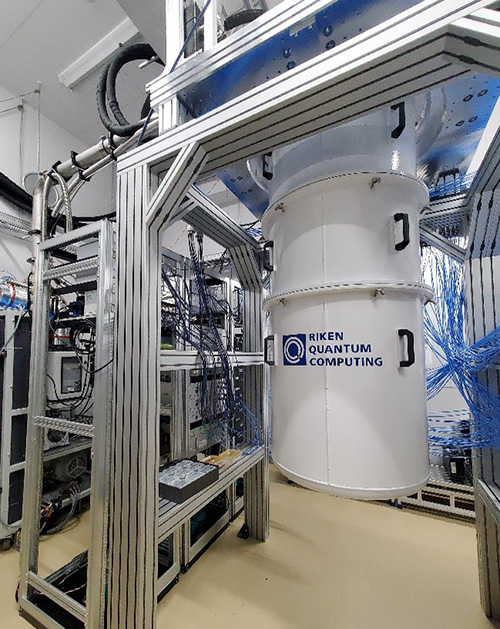
The superconducting quantum computer "Ei," Japan's first domestically produced quantum computer, installed at RQC (Wako City, Saitama Prefecture) (Photo by JETRO)
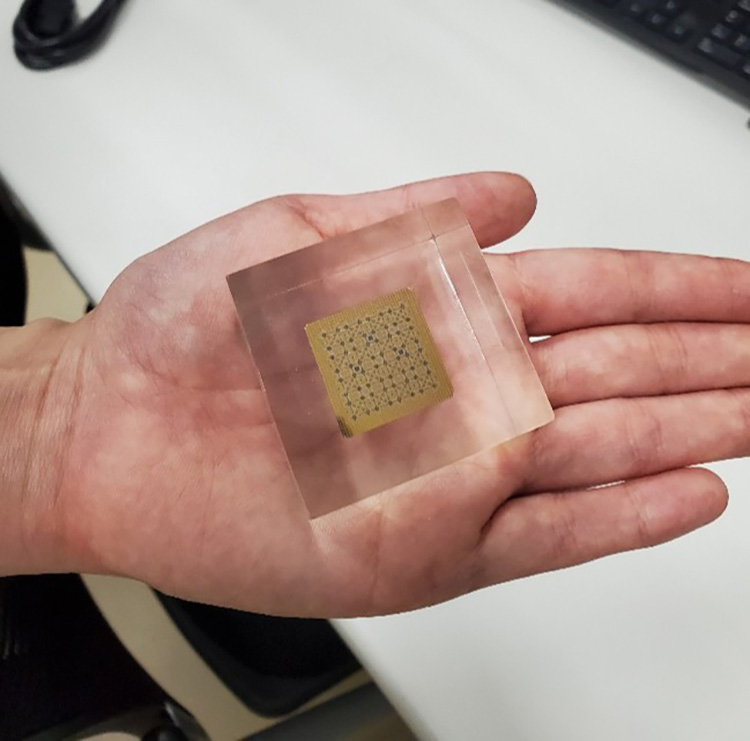
A sample of a qubit chip (Photo by JETRO)
In October 2025, Hitachi, RIKEN, and imec (Note 3) announced the signing of a memorandum of understanding (MoU) to advance the development of silicon quantum computers. By building a global research and development network, momentum in silicon quantum computing R&D is expected to be further accelerated.
RIKEN's activities are not limited to the development of quantum computers and quantum technology research. RIKEN Center for Computational Science (R-CCS) conducts research in computational science (Note 4) using high-performance computing (HPC), including the supercomputer it operates, "Fugaku." While HPC systems offer significantly faster computation than conventional computers, they are categorized as classical computers. While quantum computers are expected to enable rapid processing of calculations that would require enormous amounts of time on classical computers, they also face significant challenges in control, which are expected to be complemented by the performance of classical computers. R-CCS is researching and developing system software that links quantum and classical computers, establishing a quantum-HPC hybrid platform, and pursuing initiatives to demonstrate its effectiveness (Note 5).
RIKEN develops both the supercomputer "Fugaku" and quantum computers. According to RIKEN, it is rare for a research institution to develop both supercomputers and quantum computers in-house, enabling initiatives that could lead the world. In addition, RIKEN owns multiple quantum computers, including an ion-trap quantum computer from U.S.-based quantum computing company Quantinuum, named "Reimei," as well as IBM's superconducting quantum computer.
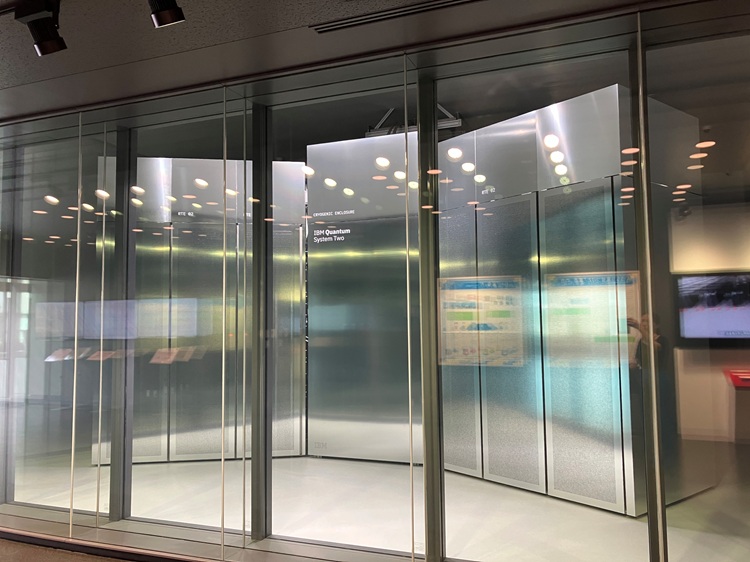
The next-generation superconducting quantum computer "IBM Quantum System Two 'ibm_kobe'," the first of its kind outside the United States,
which began operation at R-CCS (Kobe City, Hyogo Prefecture) in June 2025. It is installed near the building entrance, and freely accessible for visitors to view.
(Photo by JETRO)
An Expert Organization Dedicated to the Industrialization of Quantum Technology: G-QuAT
AIST's Global Research and Development Center for Business by Quantum-AI Technology (G-QuAT) incorporates "Business Development" and "Global" into its name and aims to serve as a unique research hub at the core of the global business ecosystem in the field of quantum technology. It promotes industry-led support for the industrialization of quantum technology, as well as the strategic expansion of collaboration with companies and research institutions worldwide.
G-QuAT is equipped with cutting-edge research facilities incorporating world-class technologies and provides integrated support from research and development to business creation through the Quantum-Classical Hybrid Computing Infrastructure (ABCI-Q), the Superconducting Quantum Circuit Fabrication Facility (Qufab), and Testbed for Quantum Computing Components (Qubed). As an example of its cutting-edge facilities, "ABCI-Q" is built around a supercomputer equipped with GPUs (Note 6) from NVIDIA of the United States, and integrates multiple quantum computing systems, including Fujitsu's superconducting quantum computer, a neutral-atom quantum computer from QuEra of the United States, and an optical quantum computer (Note 7) developed by OptQC, a Japanese quantum startup. Furthermore, in July 2025, the world's largest (Note 8) commercial quantum control system (QCS) from U.S.-based Keysight Technologies was delivered to G-QuAT. Further information on how to use the facilities is available on the G-QuAT website. Leveraging its advanced facilities and infrastructure, G-QuAT is actively engaged in cross-organizational collaboration, including participation in projects led by the New Energy and Industrial Technology Development Organization (NEDO).

Equipment installed at G-QuAT, AIST (Tsukuba City, Ibaraki Prefecture). GPU supercomputer (Source: AIST G-QuAT official pamphlet)
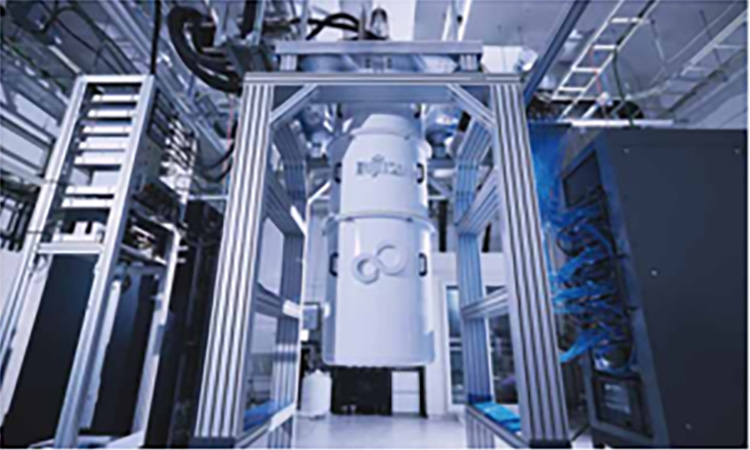
Fujitsu's superconducting quantum computing system (Source: AIST G-QuAT official pamphlet)
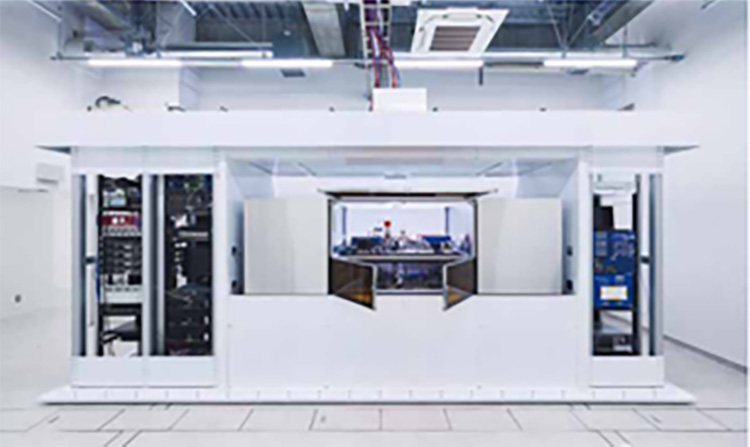
QuEra's neutral-atom quantum computing system (Source: AIST G-QuAT official pamphlet)
In addition, AIST, RIKEN, Fujitsu, and NEC prepared the report "Technology Roadmap for the Supply Chain Toward Large-Scale Quantum Computer Systems - Superconducting Approach", recognizing the importance of advancing components and materials and building supply chains for the practical application of quantum computers. Through the publication of this report, the initiative aims to encourage Japan's strong materials and manufacturing industries to enter the quantum industry, while also contributing to the establishment of a stable supply chain. Reports covering other quantum computing approaches are also planned for future publication.
Academia Supporting Quantum Technology Development
Research on quantum technology is also being conducted at many universities and other institutions. The Center for Quantum Information and Quantum Biology (QIQB) at the University of Osaka conducts a broad range of quantum technology research in addition to quantum computer development and has played an active role in advancing the development of domestically produced quantum computers. QuEL, a startup originating from QIQB, develops and manufactures control devices (Note 9) that are essential for the operation of quantum computers.
Various quantum physics research is also under way at the University of Tokyo. In 2001, the university established the Quantum-Phase Electronics Center (QPEC) on campus, and it continues to conduct research in collaboration with multiple organizations. In June 2020, the university launched the "IBM-UTokyo lab." in collaboration with IBM Japan, and in July 2020, it established the Quantum Innovation Initiative Consortium (QII). In October 2022, the "Center of Innovation for Sustainable Quantum AI (SQAI)," proposed by the University of Tokyo as the lead institution, was selected for the Japan Science and Technology Agency (JST) Program on Open Innovation Platforms for Industry-Academia Co-Creation. The University of Tokyo is leading efforts to build an R&D network connecting industry, government, and academia. SQAI is engaged in integrated industry-government-academia research with Keio University, RIKEN, OIST, the University of Chicago, Kawasaki City, and participating companies. Additionally, startups originating from the University of Tokyo, such as OptQC, which is advancing the development of optical quantum computers, and QunaSys, which develops software necessary for quantum computers, are active both domestically and internationally.
In addition to the institutions included in QIH, research on quantum technology is being advanced at other universities and research organizations as well. Institutions and universities leading quantum research are also actively engaged in talent development and international collaboration. In the field of quantum technology, which has not yet reached practical application, the role of research institutions, including universities, is particularly important. While the importance of basic research carried out by these research institutions remains unchanged, there is an increasing need to strengthen collaboration with industry as a pathway for quantum technology and to promote the real-world application of research outcomes. Japan has a solid framework supported by two complementary pillars: research institutions that produce outstanding research results and those that provide support for industrialization. Furthermore, expanding collaboration both domestically and internationally is expected to accelerate technological advancement. The accumulation of these efforts will serve as a driving force for Japan to lead the world in quantum technology development.
 (484KB)
-
Note 1:
This follows the Cabinet approval of the Integrated Innovation Strategy 2025
. 
-
Note 2:
An integrated circuit chip that creates and controls qubits, the smallest unit of quantum information. It serves as the "brain" of a quantum computer.
-
Note 3:
A world-leading semiconductor research institution in Belgium.
-
Note 4:
An academic field that aims to elucidate various natural phenomena and problems across a wide range of disciplines using computer simulations.
-
Note 5:
A project jointly proposed by RIKEN, SoftBank, the University of Tokyo, and the University of Osaka was selected for NEDO's "Research and Development of Quantum-Supercomputers Hybrid Platform for Exploration of Uncharted Computable Capabilities." Named JHPC-quantum, the project has researched and developed system software to link quantum computers (QC) and supercomputers (HPC). Using this software, a quantum-HPC hybrid platform was established, and its effectiveness has been demonstrated. For details, refer to the JHPC-quantum project titled "Research and Development of Quantum-Supercomputers Hybrid Platform for Exploration of Uncharted Computable Capabilities.
"
-
Note 6:
A processor used for handling images and video. NVIDIA leads the GPU market.
-
Note 7:
Scheduled to be introduced during fiscal year 2025 and to begin operation in fiscal year 2026.
-
Note 8:
The first commercial quantum control system capable of controlling more than 1,000 superconducting qubits.
-
Note 9:
A device that converts computational instructions from software into microwaves and outputs them to qubits, reads the results via microwaves, and returns them to the software.
Contact Us
Investing in and collaborating with Japan
We will do our very best to support your business expansion into and within Japan as well as business collaboration with Japanese companies. Please feel free to contact us via the form below for any inquiries.
Inquiry FormJETRO Worldwide
Our network covers over 50 countries worldwide. You can contact us at one of our local offices near you for consultation.
Worldwide Offices