



























How to Set Up Business in Japan Model Case Commentary: Business Setup with Factory Establishment
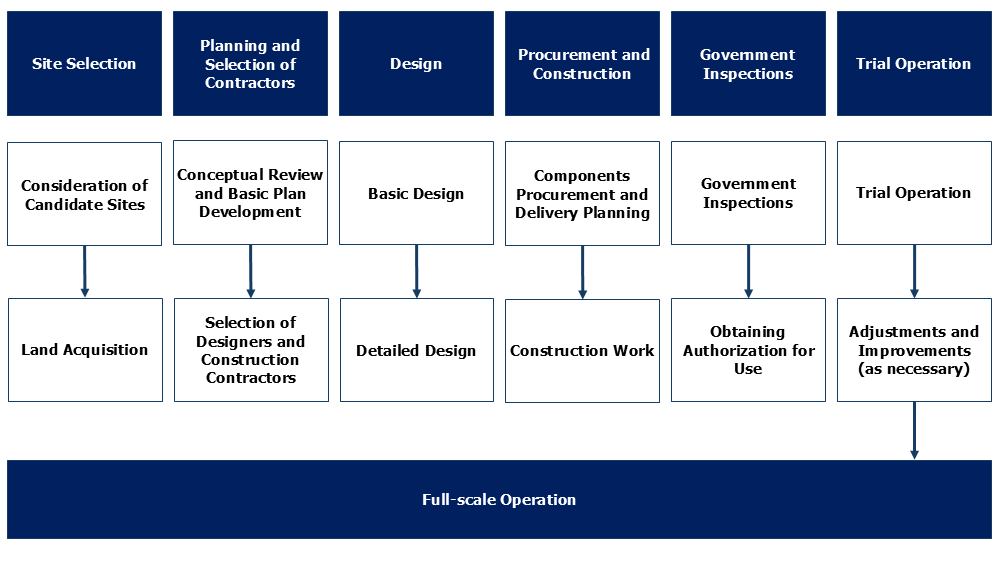
1. Site Selection
(1) Consideration of Candidate Sites
-
i.
Listing of Candidate Sites
Companies need to broadly collect and compile a list of potential sites suitable for factory construction across Japan. It is important to make use of reliable information sources regarding regional differences within Japan and land-use regulations, and to select multiple regions as candidates in order to enable parallel comparison and evaluation.
-
ii.
Examination of Geographical Conditions, Infrastructure, and Laws and Regulations
To narrow down the list of candidate sites, companies examine the feasibility and potential risks of factory establishment from the perspectives of geographical conditions, infrastructure, and applicable laws and regulations. Examples of key review perspectives include the following:
- Geographical Conditions
- Topography and ground conditions: Ease of construction considering terrain flatness and ground strength and stability, as well as building safety
- Water resources: Access to rivers, groundwater and other water sources, and the ease of securing industrial water
- Climate: Anticipated operating conditions based on temperature, humidity, wind direction, and hours of sunlight, and their suitability for the company’s industry
- Natural disaster risks: Business continuity considerations and the need for safety measures based on the level of natural disaster risks
- Infrastructure
- Transportation and logistics network: Access to roads, railways, and ports, and the efficiency and cost of transporting raw materials and products
- Energy supply: Capacity of electricity and gas supply for stable factory operations and production capability
- Municipal Water Supply: Availability of water supply and sewerage systems, industrial water, and wastewater treatment capacity
- Information and communications networks: Internet access and telecommunications infrastructure
- Labor force and living environment: Availability of local living facilities, ease of workforce recruitment, and employee retention
- Laws and Regulations:
- City Planning Act: Restrictions on the type and scale of factories and whether development permits are required
- Factory Location Act: Standards related to ratios of production facilities, green space, and environmental facilities in factory construction
- Environmental laws and regulations: Environmental regulations such as the Air Pollution Control Act, Noise Regulation Act, and Waste Management Act
- Fire Service Act: Facility standards and regulations concerning fire and disaster prevention for the storage and handling of hazardous materials
- Geographical Conditions
-
iii.
Consultation with Specialists
In addition to providing location information useful for the selection of candidate sites, introductions to local governments, and information on Japan’s legal and regulatory framework, external specialists are consulted as appropriate regarding matters such as negotiations with local governments and confirmation of subsidy requirements. Examples of such specialists include the following.
- Administrative scrivener/ First-class architects, etc.:
Preliminary consultations related to the Factory Location Act, the Building Standards Act, and other relevant laws and regulations - Tax accountant:
Tax matters related to land acquisition and construction, as well as available tax incentives - Attorneys-at-law:
Legal review of land acquisition contracts and compliance with applicable laws and regulations - Land and house surveyors:
Registration of the current status of buildings, such as factories, including descriptive registration of real property - Judicial scriveners:
Registration related to the acquisition of rights to land and constructed buildings, and the establishment of security interests - JETRO:
Provision of location-related information and introductions to local governments - Local governments:
Details of development regulations and incentive conditions
- Administrative scrivener/ First-class architects, etc.:
-
iv.
Comparative Evaluation of Candidate Sites
Based on the information collected and opinions obtained from specialists, the characteristics of candidate sites – including advantages and disadvantages, costs, and risks – must be comparatively evaluated. Through this process, companies establish priorities and narrow down the list of candidate sites.
(2) Land Acquisition
-
i.
Negotiations with Local Governments and Landowners
With respect to acquiring land for the shortlisted candidate sites, companies start negotiations with local governments and/or landowners regarding matters such as land purchase prices or lease fees, delivery conditions, and timelines for the commencement of business operations.
-
ii.
Confirmation of Financial and Fiscal Support Measures
Companies review available support measures provided by the national government and local governments such as subsidies and tax incentive programs, including their eligibility requirements, application deadlines, and required documentation. These support measures may contribute not only to cost reduction but also to the realization of the business plan and the enhancement of the overall feasibility of the project.
-
iii.
Contract Negotiations
Companies negotiate and conclude the necessary purchase or lease agreements for acquiring the land for factory establishment. Companies are also required to review the contents of contracts governed by Japanese law with support from relevant specialists as appropriate.
-
iv.
Real Property Registration
Following the execution of a land purchase agreement or lease agreement, registration of the transfer of ownership or establishment of leasehold rights is carried out to legally establish rights to the land. Where financing is obtained from financial institutions, registration of a mortgage or revolving mortgage on the land is also conducted.
2. Planning and Selection of Contractors
(1) Conceptual Review and Basic Plan Development
-
i.
Clarification of the Purpose of Factory Construction and Business Strategy
It is necessary for companies to clarify the purpose of establishing a factory in Japan and to define specific requirements such as factory scale, projected future production volume, required production capability, and the technologies and equipment to be introduced. These requirements need to be reviewed to ensure alignment with the company’s overall business strategy and global production framework.
-
ii.
Preliminary Consultations and Notifications Based on Key Laws and Regulations
To assess the feasibility of factory construction, companies conduct preliminary consultations with the relevant administrative authorities regarding key Japanese laws and regulations. These typically include confirmation of whether factory construction is permitted at the target site under the City Planning Act and the Agricultural Land Act, application of environmental standards under the Factory Location Act, and review of management systems, documentation for specified machinery, and applications for manufacturing permits under the Industrial Safety and Health Act.
-
iii.
Budget and Construction Period / Schedule Planning
Companies need to estimate the total investment required for factory construction, such as construction costs, equipment costs, and land acquisition costs, and to organize the overall process and timeline from the start of construction to commencement of operations. When preparing the plan, it is necessary to consider the time required for Japanese permitting procedures, as well as the start dates for infrastructure supply such as electricity and water, in order to establish a realistic schedule and appropriate milestones.
(2) Selection of Designers and Construction Contractors
-
i.
Determination of the Procurement Method
Companies select the procurement method for design and construction. In general, two approaches are commonly considered: (i) design and construction are contracted separately to a design firm and a construction company, and (ii) both design and construction are contracted to a single company. Under the separate contracting method, transparency throughout the design and construction processes tends to be higher, and detailed control of specifications may be easier. In contrast, under the design-build approach, coordination burdens may be reduced, and the construction period may be shortened. When selecting the procurement method, it is also necessary to ensure consistency with the parent company’s procurement policies and internal contracting rules.
-
ii.
Information Gathering
Based on the selected procurement method, companies collect information from multiple design firms and construction companies in order to shortlist contractors. When gathering information, factors such as past project experience, technical capabilities, quality and occupational safety and health management systems, reputation, and the ability to handle international projects (including language capabilities) need to be reviewed in order to select contractors that meet project requirements.
-
iii.
Proposals / Quotations Request
Companies issue a request for proposals (RFP) and/or a request for quotations (RFQ) summarizing the project requirements to shortlisted candidates and request detailed proposals and cost estimates. Companies then evaluate the proposals and estimates received in a comprehensive and objective manner, including cost, technical approach, and the feasibility of the proposed schedule, and select contractors based on the comparison.
-
iv.
Contract Negotiations
Companies start negotiations to finalize detailed terms and conditions, including contract price and payment terms, the construction schedule and penalties for delay, quality standards, and warranty provisions. Companies are required to review these terms as appropriate, based on the legal review by attorneys, and a formal contract under Japanese law is executed after clarifying each party’s responsibilities.
3. Design
(1) Basic Design
-
i.
Architectural, Structural, and Equipment Planning
At the basic design stage, companies need to establish the overall framework of the factory. This includes the building structure, layout, placement of equipment, employee flow lines, and key equipment specifications. Companies organize required conditions based on the planned production capacity and manufacturing processes and finalize the basic specifications for each item of equipment. At the same time, companies also have to confirm compliance with the parent company’s global equipment standards and Environmental, Health, and Safety (EHS) standards.
-
ii.
Estimated Cost Calculation
Based on the basic design, companies recalculate the overall estimated cost of factory construction, including construction and equipment costs. In order to avoid discrepancies in subsequent phases, cost estimates must achieve the highest possible level of accuracy at this stage.
-
iii.
Preparation for Financing
Using the estimated construction costs, companies start preparations for securing the necessary funding for the project. Companies are also required to examine financing structures, including funding from the parent company, financing by the Japanese entity, and bank loans. In addition, companies consider the potential application of support measures such as subsidies and tax incentives provided by national and local governments.
(2) Detailed Design
-
i.
Submissions and Notifications for Detailed Design and Construction
For detailed design and factory construction, various notifications, applications, and legal procedures are required. These include applications for building confirmation, notifications under the Fire Service Act and the Electricity Business Act, notifications for machinery installation pursuant to the Industrial Safety and Health Act, construction work plan notifications, and notifications under the Noise Regulation Act. Where specified chemical substances are handled, measures to prevent health hazards based on risk assessments for such substances must also be considered.
-
ii.
Detailed Architectural, Structural, and Equipment Planning
Based on the specifications defined during the basic design phase, companies develop detailed designs with actual operations in mind. This includes determining specifications for building materials, detailed structural plans based on structural calculations (including internal traffic flow and equipment layout), routes for transporting raw materials and products, equipment model numbers, and piping routes. Companies carry out design optimization from the perspectives of constructability, cost efficiency, and safety.
-
iii.
Preparation of Detailed Design Drawings
Companies prepare detailed design drawings for actual factory construction. These include numerous technical drawings such as architectural drawings, structural drawings, equipment drawings, electrical drawings, and piping drawings. Such drawings serve as essential reference documents for contractors and have a significant impact on both construction quality and the construction schedule.
4. Procurement and Construction
(1) Components Procurement and Delivery Planning
-
i.
Selection of construction materials, equipment and components
Based on the specifications set out in the detailed design drawings, companies select construction materials, equipment, and components that meet required standards for quality, cost, and performance. Companies adopt equipment that complies with head office specifications and global standards. Where imported components are required, additional coordination and confirmation of delivery schedules may be necessary.
-
ii.
Supplier Selection
Companies select suppliers by comparing factors such as price, quality, delivery time, and procurement risk. Companies obtain quotations from multiple suppliers as needed and compare them. When overseas products or custom-made equipment is used, additional considerations are required, including import procedures, customs clearance, and confirmation of compliance with domestic safety standards.
-
iii.
Development of a Delivery Plan Aligned with the Construction Schedule
Companies develop a delivery plan aligned with the detailed construction schedule, taking into account delivery routes, on-site storage capacity, and safety measures. As the timing of material deliveries is closely linked to construction progress and delivery delays can directly lead to project delays, careful schedule management is required. When importing products or equipment from overseas, sufficient lead time is needed for transportation and fluctuations in international logistics.
(2) Construction Work
-
i.
Pre-Construction Compliance Verification
Prior to the commencement of construction work, companies confirm that the building confirmation application has been approved and that required notifications—such as road occupancy permits and waste disposal notifications—have been completed. Companies also verify compliance with relevant laws and regulations, including the establishment of a safe working environment, the provision of safety training, and the conduct of health examinations under the Ordinance on Industrial Safety and Health.
-
ii.
ii. Formulation of the Construction Plan
To ensure that construction proceeds safely and efficiently, companies formulate a detailed construction plan. This plan includes a construction schedule, quality control plan, and safety management plan, and integrates schedules for building construction, equipment installation, and electrical work.
-
iii.
Construction Work
Companies carry out construction work sequentially in accordance with the construction plan, including foundation work, steel frame construction, exterior and interior finishing, and equipment installation. Throughout the process, companies are required to monitor construction quality to ensure consistency with design specifications, and to confirm that necessary adjustments are made in response to on-site conditions.
-
iv.
Schedule Management
Companies manage construction progress against the established schedule and confirm that construction is proceeding according to plan. In the event of delays caused by factors such as material delivery issues, weather conditions, or construction-related problems, companies must implement appropriate countermeasures promptly to minimize the impact and ensure completion within the planned timeframe. Contractors are required to provide regular progress reports and to review and revise schedules as necessary.
5. Government Inspections
(1) Government Inspections
-
i.
Inspections by Relevant Administrative Agencies
Upon completion of factory construction, inspections are conducted by relevant administrative agencies, such as completion inspections under the Building Standards Act and fire inspections under the Fire Service Act. Inspection items include the overall building structure, installation status of equipment and machinery, firefighting and fire prevention equipment, and the condition of piping and electrical systems. These inspections verify compliance with applicable laws and standards.
(2) Obtaining Authorization for Use
-
i.
Acquisition of Required Notifications and Permits
Once compliance has been confirmed through administrative inspections, companies proceed with the acquisition and completion of the notifications and permits required for factory operations. These include permits and notifications related to pollution control, the issuance of inspection certificates for specified machinery under the Industrial Safety and Health Act, certification of machinery, tools, and protective equipment subject to inspection, and the appointment and notification of safety managers, health managers, and industrial physicians. By completing these necessary procedures, companies can legally commence factory operations. In addition, companies must complete a building description registration and, where the building is owned, a preservation registration of building ownership in order to legally establish rights related to the building. Procedures should be conducted with due consideration not only to Japanese laws and standards but also, where necessary, to alignment with applicable global standards.
6. Trial Operation
(1) Trial Operation
-
i.
Individual Equipment Trial Operation
Companies conduct trial runs for each individual piece of equipment and machinery to confirm proper operation, including the functioning of performance and safety devices. At this stage, companies make initial settings and adjustments and verify operation against detailed design specifications.
-
ii.
Integrated Trial Operation
After confirming individual equipment operation, companies conduct integrated trial operations to verify that the entire production line functions smoothly as a single, continuous process. This includes verifying that the entire process from raw material input to product output functions properly, checking line synchronization and the balance between processes, and confirming the coordinated operation of safety systems. Companies also verify that production capacity and quality control are not adversely affected and confirm that any necessary fine adjustments are made as required.
(2) Adjustments and Improvements (as necessary)
-
i.
Resolution of Initial Defects
Companies need to address any equipment or system malfunctions, design errors, or operational procedure problems identified during trial operations through corrective actions such as equipment adjustments, replacement of parts, or program modifications. Companies then continue to make improvements as necessary until all defects and issues are fully resolved, and stable production conditions are achieved in preparation for full-scale operation.
JETRO supports your business in Japan
We provide consistent one-stop service for establishing a base or expanding business in Japan. See the details of support services that JETRO provides when setting up business in Japan.
Contact Us
Investing in and collaborating with Japan
We will do our very best to support your business expansion into and within Japan as well as business collaboration with Japanese companies. Please feel free to contact us via the form below for any inquiries.
Inquiry FormJETRO Worldwide
Our network covers over 50 countries worldwide. You can contact us at one of our local offices near you for consultation.
Worldwide Offices