



























Building a Domestic Offshore Wind Supply Chain in Japan Through International Collaboration
Japan's Offshore Wind Power Industry (Part 1)
May 1, 2026
Expanding the adoption of renewable energy sources—which do not emit carbon dioxide (CO2)—is essential for achieving the goal of “carbon neutrality by 2050” set by the Japanese government. The government has outlined a policy to increase the share of renewable energy in the power source composition of the 2040 energy mix to 40-50% (see Table 1), with wind power accounting for approximately 4-8% of that total. Offshore wind power has attracted attention because it enables large-scale, high-volume deployment among renewable energies, and faces fewer land-use constraints. While Japan has a small land area and is largely mountainous, it possesses the sixth-largest Exclusive Economic Zone (EEZ) in the world, and the utilization of the marine space has the potential to contribute to improving the country's energy self-sufficiency rate. In addition, offshore locations offer the advantage of higher capacity utilization rates because average wind speeds are stronger, and wind conditions are more stable than on land.
In this two-parts series, this article provides an overview of efforts to establish a supply chain for the offshore wind power industry in Japan. In Part 1, after reviewing international trends in offshore wind power and the current status of its deployment in Japan, we examine initiatives to collaborate with and attract foreign companies in order to establish a domestic supply chain, including for floating offshore wind power systems that are expected to expand in the coming years.
| Power Source | FY2023 (Preliminary) | FY2040 (Forecast) |
|---|---|---|
| Renewable Energy | 22.9% | 40-50% |
| Solar | 9.8% | 23-29% |
| Wind | 1.1% | 4-8% |
| Hydropower | 7.6% | 8-10% |
| Geothermal | 0.3% | 1-2% |
| Biomass | 4.1% | 5-6% |
| Nuclear Power | 8.5% | 20% |
| Thermal Power | 68.6% | 30-40% |
-
Source:
Prepared by JETRO based on "Outlook for Energy Supply and Demand in FY2040 (reference material) " by the Agency for Natural Resources and Energy.
Global Deployment Volume Expands with Larger Turbines and Commercialization of Floating Offshore Wind Turbines
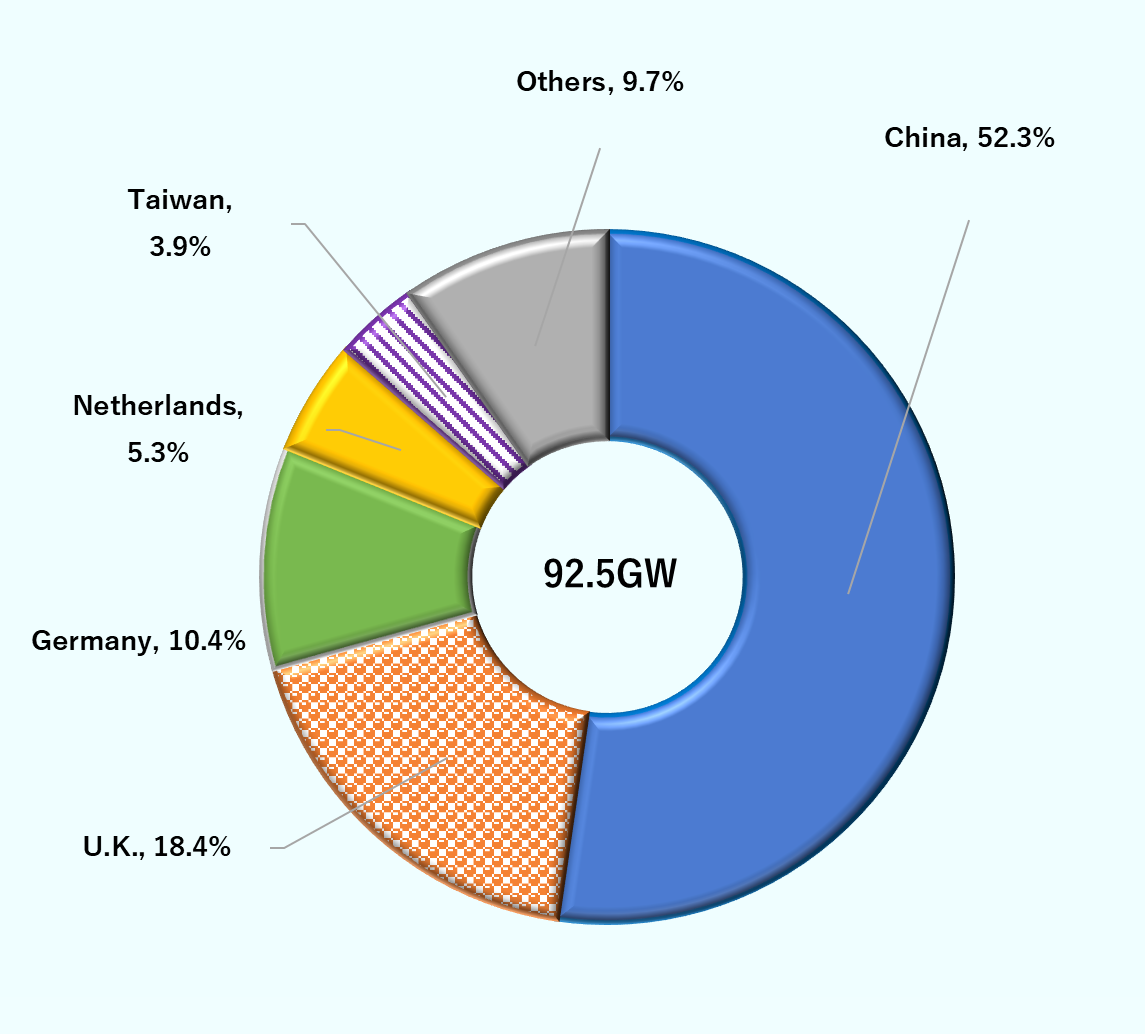
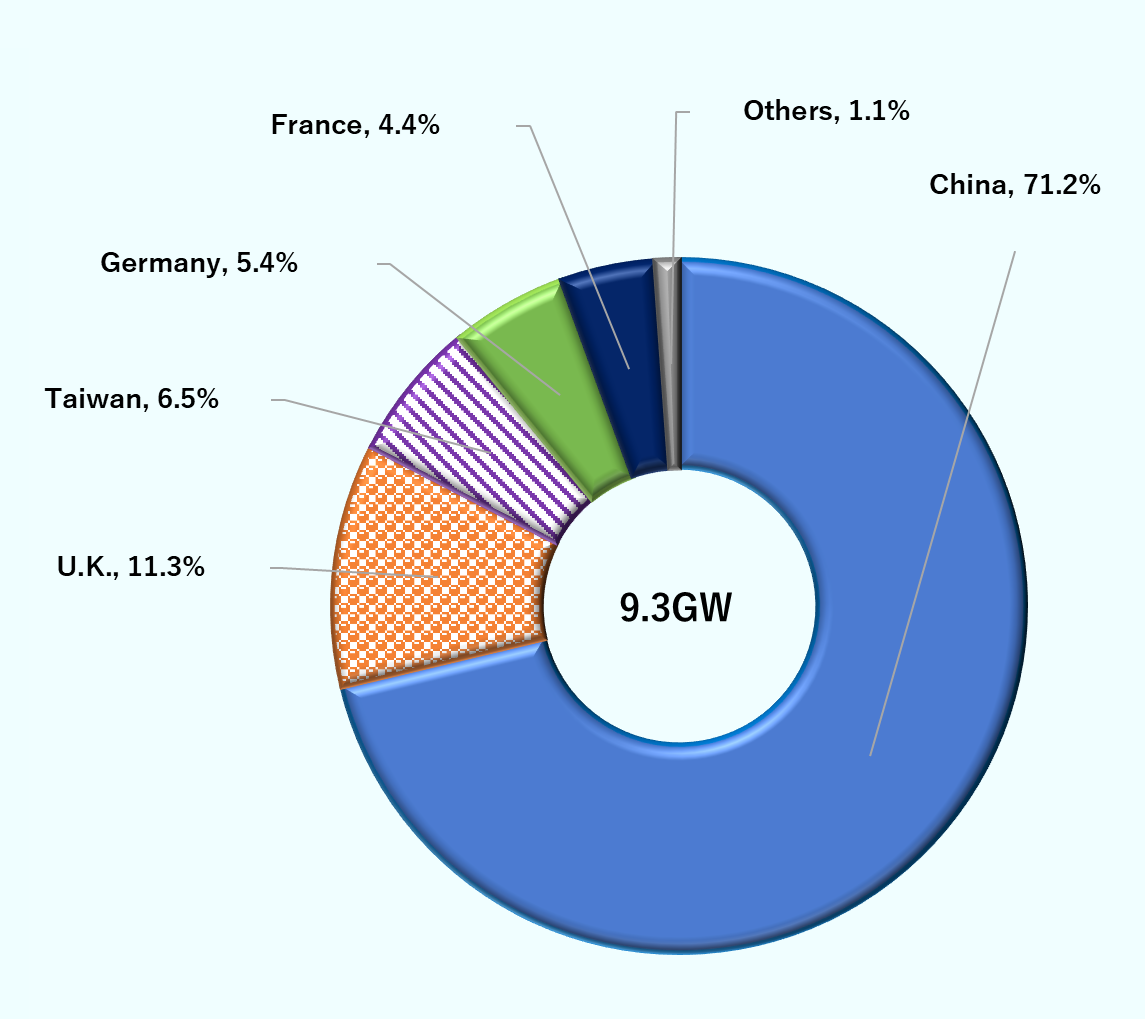
According to the "Global Wind Report 2026 (20.8MB)" published by the Global Wind Energy Council (GWEC) in April 2026, the cumulative installed capacity of global offshore wind power as of 2025 expanded approximately 2.6 times from 36.1 gigawatts (GW) in 2020 to 92.5 GW. By region, China accounted for 48.4 GW (52.3%) and Europe for 38.8 GW (41.9%) (see Figure 1). New installations reached 9.3 GW in 2025, up 16% from the previous year and marking the third-largest volume on record. China was the center of the new installation market, accounting for 70% of the total and ranking first in the world for the eighth consecutive years, and the top five countries and regions, including the United Kingdom, Taiwan, Germany, and France, accounted for approximately 99% of the total (see Figure 2).
Source: Prepared by JETRO based on "Global Wind Report 2026" by the Global Wind Energy Council (GWEC).
Europe has a long history of advancing offshore wind power, beginning with demonstration projects and commercial deployment since the 1990s, led primarily by Denmark and the Netherlands, followed by the United Kingdom and Norway, which have subsequently expanded their offshore wind markets. The reasons Europe became a pioneer in offshore wind power include its longstanding efforts to address energy security and reducing greenhouse gas emissions simultaneously, as well as geographic conditions, including shallow coastal waters and strong winds throughout the year. Furthermore, a notable trend in recent years is the rapid growth of offshore wind installations volume in China, driven by its vast domestic market.
The global increase in installation volume is driven by the trend towards larger turbines and the practical application of floating offshore wind power. Larger offshore wind turbines not only lead to more efficient power generation but also improve maintenance efficiency by reducing the number of turbines required to achieve the same power generation capacity. Furthermore, the reduced need for foundation structures and subsea cables is expected to lower the environmental impact associated with the construction and installation phases. While onshore wind power faces challenges of securing land and transportation constraints as turbines grow larger, offshore wind power has the advantage of utilizing vast ocean areas and installing massive turbines by vessels. While wind turbines with blade diameters of approximately 80 meters and a generating capacity of around 2 megawatts (MW) were the mainstream in the 2000s; today, turbines with blade diameters of roughly 150 meters and a generating capacity of 10-15 MW are now becoming the standard.
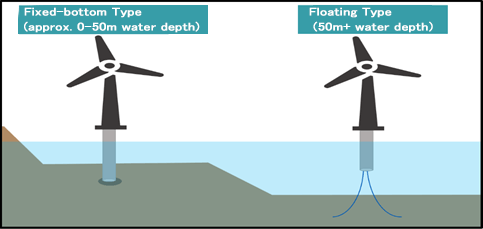
In addition to the fixed-bottom offshore wind systems—traditionally been the mainstream approach, in which foundations are installed directly on the seabed—the commercialization of floating offshore wind systems, which can be deployed in deeper waters, has been advancing in recent years (see Figure 3). Floating systems are well suited to countries with rugged offshore seabed topography, such as Japan, and if demonstration projects progress successfully, the potential for domestic deployment in the future is large.
Source: Prepared by JETRO based on "What Is Offshore Wind Power? — Why Is It Attracting Attention Now?"
from AIST Magazine, National Institute of Advanced Industrial Science and Technology (AIST).
Offshore Wind Power Supporting Japan's Transition to Renewable Energy as a Main Power Source
According to the Japan Wind Power Association (JWPA), Japan's cumulative capacity of full-scale offshore wind power (defined as those that cannot be directly accessed from land and require vessel transportation) reached approximately 253.4 MW as of the end of 2024. In its "Vision for Offshore Wind Power Industry," the Japanese government has set targets of installing 10 GW of offshore wind power capacity by 2030 and 30–45 GW by 2040. In the 7th Strategic Energy Plan as well, offshore wind was positioned as a key strategy for making renewable energy the nation's main power supply.
Offshore wind power projects are large in scale and involve a broad range of industries. Since a wide range of industries are involved—including the manufacturing of wind turbines and foundation structures, port infrastructure development, marine construction, and operations and maintenance, it is expected to create employment opportunities across diverse sectors. In addition, the growth of related industries is anticipated to produce significant economic spillover effects for regional economies. Under the Act on Promoting the Utilization of Sea Areas for the Development of Renewable Energy Power Generation Facilities, the Ministry of Economy, Trade and Industry (METI) and the Ministry of Land, Infrastructure, Transport and Tourism (MLIT) have designated 38 areas nationwide as Promotion Areas, Promising Areas, and Preparation Areas as of October 3, 2025.
Building a Domestic Supply Chain Is a Challenge, International Collaboration Is the Key
While offshore wind power has a broad industrial base with multiple layers, it is also susceptible to factors such as supply chain constraints and inflation due to the large scale of investment and the long project duration. In Japan, a Mitsubishi Corporation-led consortium announced in August 2025 its withdrawal from three projects in the first-round—Choshi (Chiba Prefecture), Noshiro-Mitane-Oga (Akita Prefecture), and Yurihonjo (Akita Prefecture) ( ref. METI document "Offshore Wind Power Generation"). According to the Renewable Energy Institute, soaring costs are common challenges overseas as well, and even in European countries that are leaders in offshore wind power, such as Denmark and the United Kingdom, project withdrawals and zero-bid auctions have occurred. Labor shortages and soaring fossil fuel prices due to the COVID-19 pandemic and Russia's invasion of Ukraine are believed to be having serious impacts.
The Japanese government views this situation as an opportunity to catch up with other countries in terms of technology and supply chains and is therefore strengthening its industrial strategy for floating offshore wind power. To increase resilience against inflation and exchange rate fluctuations, strengthening domestic supply chains and promoting localization are effective measures to address both costs and risks. The industry has set a target of achieving a 60% domestic procurement ratio by 2040.
However, several challenges remain in developing a domestic supply chain, including a shortage of large-scale turbine manufacturing facilities and offshore installation vessels, as well as the lack of large-scale shipyards required for the mass production of floating foundations. To bridge this gap in domestic supply capacity, collaboration with foreign companies that already possess established technological expertise and mass production capacity is considered an effective approach. Manufacturers—primarily based in Europe, that have produced some of the world's largest wind turbines, are regarded as important partners due to their technological strengths and large-scale manufacturing capacity, and global collaboration is advancing among both public and private sectors.
In Europe, companies such as Siemens Gamesa (Spain) and Vestas (Denmark), which established mass production systems for large-scale wind turbines, have a proven track record of successfully strengthened their supply chains by setting up manufacturing bases across various European countries at an early stage and promoting joint development with local component manufacturers.
The Japanese government is also open to public-private partnerships with leading global wind turbine manufacturers. In June 2025, METI launched a public-private cooperation framework with Siemens Gamesa. In March 2026, METI and Vestas signed a Memorandum of Cooperation (MoC) on the establishment of wind power equipment manufacturing facilities in Japan. Based on the expectation of continued expansion of Japan's offshore wind market, the company has formulated a roadmap to establish a final assembly facility for nacelles (the component that houses key equipment such as generators) in Japan by FY2029, and a full nacelle production facility by FY2039. The company is also deepening its partnerships with Japanese companies, including through the signing of Memorandums of Understanding (MoUs) with Nippon Express and DENZAI aimed at strengthening the domestic supply chain.
Going forward, it is important to advance international collaboration at an early stage particularly in the field of floating offshore wind power, as its importance increases in promoting the utilization of Japan's EEZ. It will be necessary to establish a framework to create a virtuous cycle of technological development, human resource development, and investment promotion.
The Japanese government has set a target of developing floating offshore wind power projects totaling 15 GW or more by 2040. In addition, amendments to the Act on Promoting the Utilization of Sea Areas for the Development of Renewable Energy Power Generation Facilities were enacted in June 2025, enabling the installation of offshore wind power facilities within the EEZ. Under the policy, the Floating Offshore Wind Technology Research Association (FLOWRA) established in March 2024, places a high priority on collaboration with overseas organizations—including those in Europe and the United States—and is working to reduce the cost of floating offshore wind power technologies and establish mass production techniques.
Furthermore, as part of government initiatives, subsidies and funds dedicated to the offshore wind sector, including the GX Supply Chain Development Support Project, have been established (see Table 2). These programs are provided to local governments, private companies, research institutions, and others. In Part 2, we will cover a seminar hosted by JETRO in February 2026 aimed at revitalizing the domestic offshore wind industry, introducing European initiatives to monetize the supply chain, as well as examples of regional consortiums that have proven attractive to foreign companies.
| Project / Program Name | Budget Amount | Eligible Activities | Subsidy rates |
|---|---|---|---|
| GX Supply Chain Construction Support Project | 421.2 billion yen (Note 1) | Projects that make capital investments related to the production of floating offshore wind power generation facilities, etc. |
Large enterprises: Up to one-third Small and medium enterprises, etc.: Up to one-half |
| Green Innovation Fund Project (Offshore Wind Power Cost Reduction Project) | 210.97 billion yen (Note 2) | Development of core technologies such as floating structures and cables; floating structure demonstration projects aimed at deployment in the EEZ and the Asia-Pacific region, and cost reduction of construction in deep waters. | Up to 1/2 or 2/3+ 1/10 incentive |
| FY2025 Subsidy for Promotion of Offshore Wind Project Development | - (Note 3) | Tasks related to providing information to the national government and coordinating with stakeholders, targeting prefectures that are moving forward with offshore wind power project development. |
Areas not designated as preparation zones: Fixed amount (up to 25 million yen) Preparation zones: Up to 1/2 (up to 10 million yen) |
-
Note 1:
Includes national treasury debt burden through FY2028. Total amount combined with subsidies for perovskite solar cells.
-
Note 2:
Total project amount as of November 2025 (national treasury burden only; including incentives).
-
Note 3:
Total budget for FY2025 is not disclosed.
-
Source:
Prepared by JETRO based on websites of respective projects and implementing organizations.
Contact Us
Investing in and collaborating with Japan
We will do our very best to support your business expansion into and within Japan as well as business collaboration with Japanese companies. Please feel free to contact us via the form below for any inquiries.
Inquiry FormJETRO Worldwide
Our network covers over 50 countries worldwide. You can contact us at one of our local offices near you for consultation.
Worldwide Offices


