



























Battery Storage Supporting Decarbonization
Outlook for the Fuel Cell and Battery Storage Market (Part 1)
August 31, 2026
As the global trend toward decarbonization accelerates, the expansion of renewable energy, the electrification of mobility, and the utilization of hydrogen energy have become critical challenges.
The JETRO webinar titled “Utilization of Fuel Cells and Energy Storage Systems to Promote Carbon Neutrality,” was held on June 30, 2026.
This article provided an overview—divided into two parts—of the characteristics and market trends of these two technologies, the Japanese government’s policies, and prospects. Part 1 focuses on battery storage. While demand for electric vehicles (EVs) has driven growth in the battery storage market, the importance of stationary battery storage, particularly grid-connected systems—has been increasing in recent years, driven by the expansion of renewable energy adoption and rising demand for data centers supporting artificial intelligence (AI).
Growing Demand for Energy Storage Systems Across Diverse Applications
Energy storage systems are technologies that store electricity for use when needed, and they are one of the fundamental technologies supporting decarbonization. The largest application is on-board energy storage systems for EVs (Note 1), and the market is expanding rapidly against the backdrop of the ongoing electrification of automobiles worldwide. Furthermore, with the expansion of renewable energy adoption and increasing electricity demand, their importance is also growing as technologies that support grid stabilization and the efficient use of electricity.
Solar and wind power are variable renewable energy (VRE) sources, whose generation fluctuates depending on weather conditions and time of day; therefore, supply-demand balancing is essential for a stable power supply. Until now, this role has been primarily fulfilled by thermal power generation and pumped-storage hydropower (Note 2). However, as the share of renewable energy rises, situations are arising where conventional supply-demand balancing—relying solely on thermal power generation and similar methods—is no longer sufficient. When power generation is projected to exceed electricity demand or transmission capacity, there has been an increase in “output control,” whereby power generators are required to temporarily curtail their output. In response to these challenges, battery storage systems contribute to the effective utilization of renewable energy and the stabilization of the power grid by storing surplus electricity and discharging it when there is a shortage.
Based on their primary applications, storage batteries can be categorized as: (1) “storage batteries on vehicles,” which are used as a means of transportation and also serve as energy storage devices; (2) “grid-scale battery energy storage systems,” designed to stabilize the power grid; and (3) “residential storage batteries,” intended to optimize electricity usage in household.
Vehicle batteries are used as the power source for EVs. EVs include battery electric vehicles (BEVs), hybrid electric vehicles (HEVs), plug-in hybrid electric vehicles (PHEVs), and fuel cell electric vehicles (FCEVs). Among these, BEVs require high-capacity batteries compared to other electric vehicles because they derive all their propulsion energy from the batteries Consequently, as countries tighten regulations and advance electrification policies aimed for decarbonization, the growing adoption of BEVs is significantly boosting demand for automotive batteries, making it one of the primary drivers of growth for the overall battery market.
Grid-scale batteries are large-scale systems deployed by transmission and distribution utilities and power generators. By charging and discharging in response to supply-demand balances and fluctuations in renewable energy output, they contribute to the effective utilization of surplus electricity and the stable operation of the power grid. Residential batteries are often installed in conjunction with solar power generation systems; by storing electricity generated during the daytime for use at night, they enable households to reduce the amount of electricity they purchase and improve their energy self-sufficiency.
Demand for Stationary Battery Storage Is Also Rising as Renewable Energy Adoption Expands
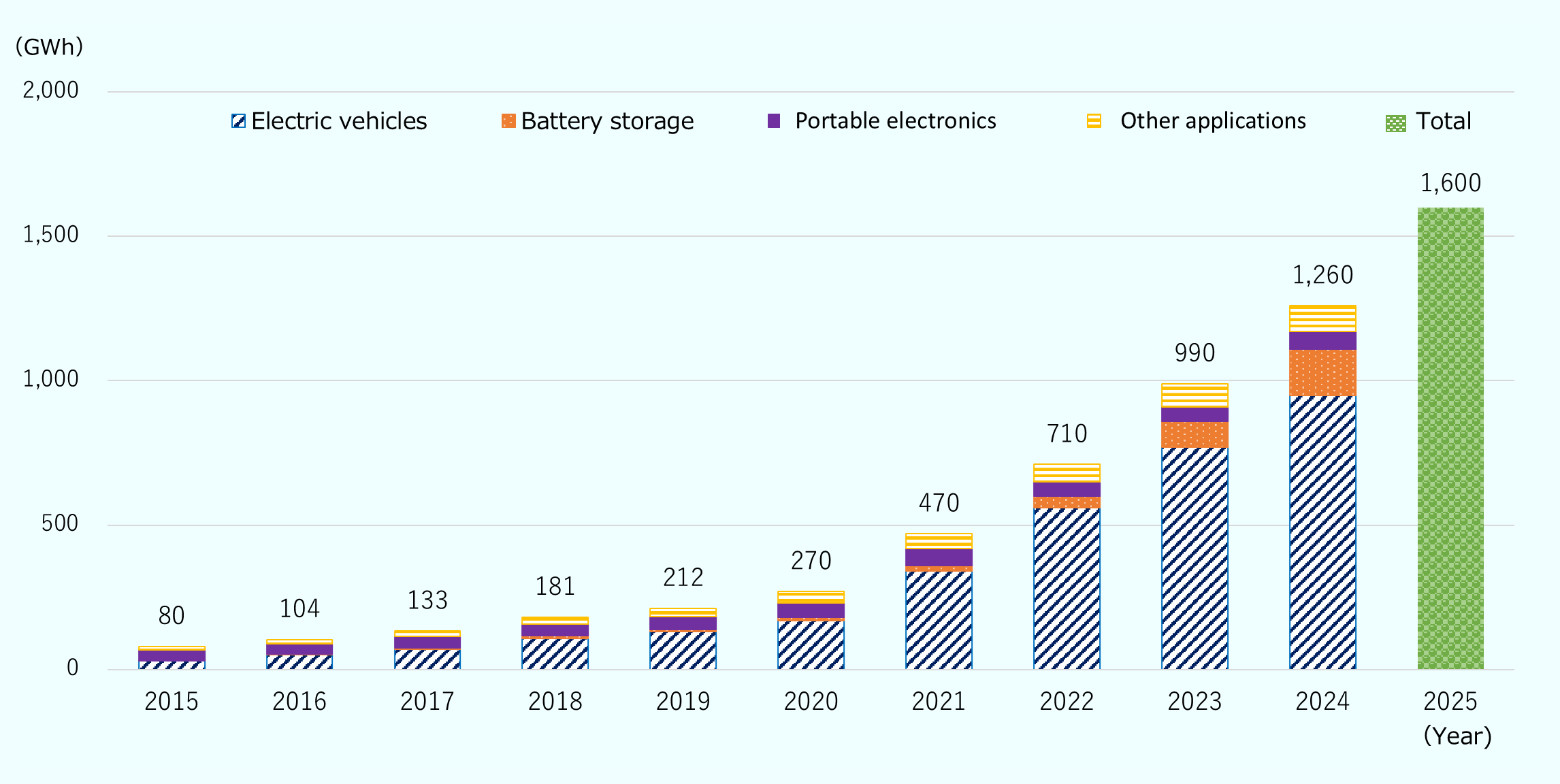
The battery storage market is expanding rapidly worldwide. According to the International Energy Agency (IEA), global installed capacity of lithium-ion batteries was projected to exceed 1,600 gigawatt-hours (GWh) by 2025, representing approximately a sixfold increase compared to 2020 (see figure). Although demand is primarily driven by EVs, demand for stationary battery storage is also steadily increasing against the backdrop of expanding renewable energy adoption.
-
Notes:
2025 data estimated based on latest available data. Other applications include electric bikes, hoverboards and drones, among others.
-
Sources:
Prepared by JETRO based on data from IEA (2025) Global EV Outlook; IEA (2025) World Energy Outlook; Avicenne Energy; CRU.
On the other hand, demand forecasts for 2030 range from approximately 1,600 to 2,900 GWh, with significant variation depending on the research organization. While the market shows strong growth potential, uncertainty remains regarding future demand.
Against the backdrop, the Japanese government is working to strengthen the competitiveness of the battery industry. The GX2040 Vision approved by the Cabinet in February 2025, designates energy storage batteries as critical materials, and in June 2026, the government announced the “Energy Storage Battery and Power Supply Industry Strategy” (Note 3). The government aims to establish a domestic manufacturing base capable of producing 150 GWh annually between 2030 and the mid-2030s. It also places a strong emphasis on strengthening industrial competitiveness by providing comprehensive energy storage solutions centered on storage batteries to meet high-value-added needs. On the other hand, critical minerals such as lithium, nickel, cobalt, and graphite —which are key raw materials for storage batteries —are highly dependent on specific countries, raise concerns about supply instability due to geopolitical risks and export restrictions. The government has identified strengthening the supply chain—through diversifying suppliers, securing overseas mining interests, and promoting recycling—as a key priority.
During the webinar, the Vietnamese startup Alterno was introduced as a case study in battery utilization. The company has established a Japanese base in Tsukuba City, Ibaraki Prefecture, and has been developing “sand battery” technology, a thermal energy storage system that utilizes the heat storage capacity of sand. The system converts surplus electricity generated from renewable energy sources into heat and stores that thermal energy in sand. By using readily available sand and replacing heat generated from fossil fuels, the technology is expected to be cost-effective and reduce carbon dioxide emissions. Another key feature is its low risk of fire, unlike conventional lithium-ion batteries that use flammable electrolytes.
Growing Demand for Data Center Storage Batteries
Recently, with the spread of AI and the advancement of digitalization, global demand for power for data centers has been surging. Data centers are critical digital infrastructure that supports social and economic activities, and because they require stable operation 24 hours a day, 365 days a year, a highly reliable power supply is essential.
Diesel generators have traditionally been the mainstream choice for emergency backup power, and battery storage systems have been used as a temporary backup until the emergency generator kicks in during a power outage. However, in recent years, as battery storage capacities have increased, there has been a gradual expansion in the adoption of these systems—not only for power outage mitigation but also to expand the use of renewable energy, optimize electricity costs, strengthen business continuity plans (BCPs), and support decarbonization efforts. Because they can be used not only for their traditional role as emergency power sources but also for the effective utilization of renewable energy and the smoothing of peak demand, they are attracting attention as facilities that contribute to both improving data center operational efficiency and achieving decarbonization.
Furthermore, data centers for AI consume large amounts of electricity. The GX2040 Vision outlines a policy to promote the location of data centers in regions with abundant decarbonized power sources. Through “Watt-Bit Collaboration” (Note 4)—which involves integrated planning of power supply and data center locations—the government aims to realize the effective use of clean energy and the creation of regionally distributed industrial clusters, with the goal of simultaneously achieving a stable energy supply, economic growth, and decarbonization. Furthermore, the aforementioned “Battery and Power Supply Industry Strategy” also cites the expanding demand for AI-focused data centers as a significant market opportunity. As the construction and expansion of data centers proceed, stationary batteries are expected to play an increasingly important role as infrastructure that supports a stable power supply and the utilization of renewable energy.
-
Note 1:
In this article, “EV” is used as a term referring to electric vehicles in general.

-
Note 2:
A system in which surplus electricity is used to operate pump turbines during periods of low electricity consumption, such as at night, to lift water from a lower elevation to a higher one; during periods of high electricity demand, such as during the daytime, the water is released to turn pump turbines and generate electricity.
-
Note 3:
The “Storage Battery Industry Strategy” (August 2022) was revised to the “Storage Battery and Power Supply Industry Strategy” (June 2026).
-
Note 4:
This refers to efficiently advancing initiatives—such as the development of power infrastructure (including decarbonized power generation facilities and power grids), the siting of data centers, and the development of telecommunications infrastructure—while considering overall optimization and effectively integrating power and telecommunications systems.
Contact Us
Investing in and collaborating with Japan
We will do our very best to support your business expansion into and within Japan as well as business collaboration with Japanese companies. Please feel free to contact us via the form below for any inquiries.
Inquiry FormJETRO Worldwide
Our network covers over 50 countries worldwide. You can contact us at one of our local offices near you for consultation.
Worldwide Offices


