



























November 2026
Creating a Global Business Hub Through "The NEW NARITA AIRPORT Project"
Nov 20, 2026
Currently, at Narita International Airport—Japan's gateway to the world—a major development project, often referred to as the "second opening of the airport" is underway, involving the construction of new and extended runways as well as a new passenger terminal. These developments hold immense potential not only for Japanese companies, but also for overseas firms considering market entry into Japan or looking to expand their logistics and business operations across the Asian region.
Located adjacent to Tokyo, Narita International Airport is Japan's largest trade gateway and has long supported the movement of both goods and people of the country as an international hub connecting North America and Asia. With its excellent access to the Tokyo metropolitan area and an extensive international route network, it serves as a critical piece of infrastructure supporting business activities both in Japan and abroad.
In recent years, the importance of international logistics has grown significantly, driven by the recovery and expansion of global aviation demand and the restructuring of supply chains. Meanwhile, existing airport capacity in the Tokyo metropolitan area is reaching its limits in the face of rising demand. Strengthening the functions of Narita Airport, Japan's largest trad gateway, is of the utmost importance for sustaining and fostering robust economic activity. Against this backdrop, what is known as the "The NEW NARITA AIRPORT Project" is now underway. Through initiatives such as the construction and extension of runways, the consolidation of airport operations into a single terminal, the development of a new cargo area, and the enhancement of airport access, the project aims to fundamentally enhance the airport's capabilities.
These functional enhancements are being implemented in phases, with projects including the construction of a new runway, the extension of an existing runway, and the development of a new cargo area, targeting completion in the first half of the 2030s. In parallel with the expansion of airport capacity, the development of industrial and urban infrastructure in the surrounding areas is also planned, which is drawing significant attention as a large-scale regional development project with a roughly ten-year horizon.
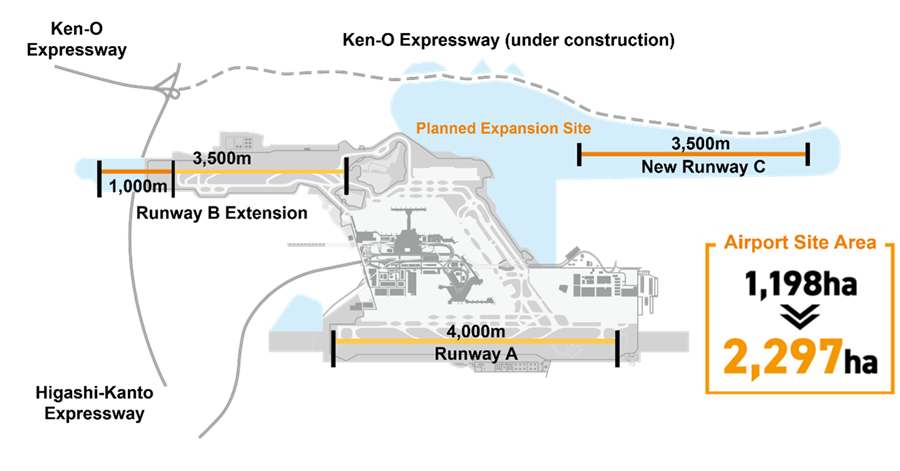
"The NEW NARITA AIRPORT Project"
The Vision for SORATO NRT Airport City
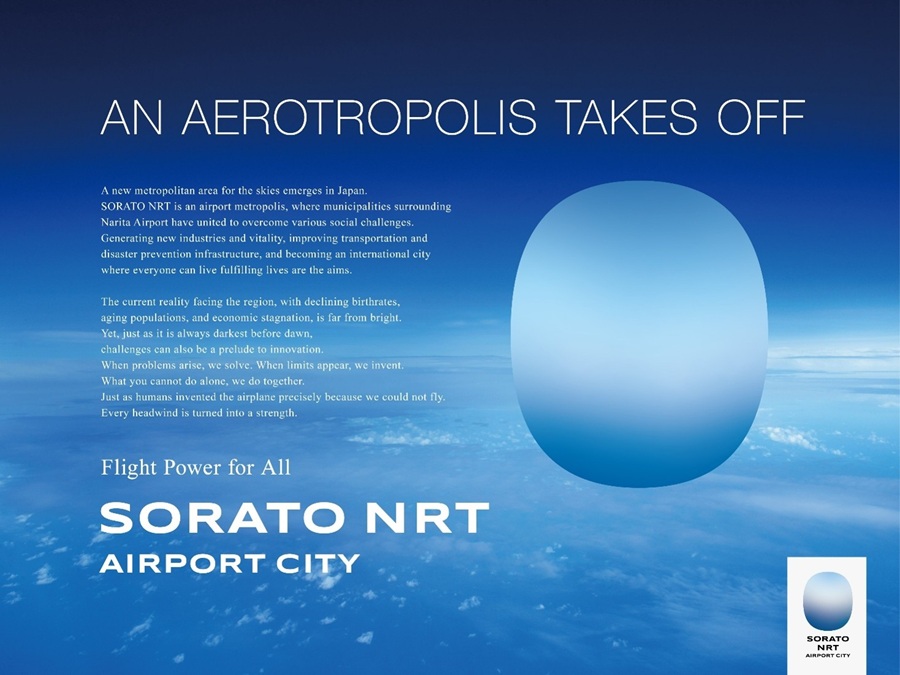
To maximize the effects of the "The NEW NARITA AIRPORT Project" not only for the airport itself but also for the surrounding areas, SORATO NRT (Narita) Airport City Project has been formulated. With the vision of creating a "A flagship airport city with global resonance where everyone shines," SORATO NRT aims to form a new urban area that integrates airport functions and urban functions. In tandem with the enhancement of Narita Airport's capabilities, industrial and urban development projects in the surrounding area are planned to be implemented in phases over the next decade or so.
The term "Flagship Airport City" as used here does not simply refer to development around an airport or the establishment of an industrial hub. Rather, centered on the airport, it envisions an integrated metropolitan area where multiple functions, including economic activity, the movement of people and goods, residential communities, and living environments, are interconnected to generate synergistic value. Its defining characteristic lies in the pursuit of an urban model in which the airport serves not merely as a point of transit, but as a hub for business activity, talent exchange, and value creation.
While Narita International Airport boasts an extensive international network serving the largest number of destinations among airports in Japan, along with a significant trade function, the areas surrounding the airport offer greater room for development compared to the city center. Against this backdrop, SORATO NRT plans to promote the phased development of industrial hubs in the airport vicinity, which is expected to create new location opportunities for both domestic and international companies.
The airport city area is envisioned not only as a place to work but also as a place to live. Accordingly, the integrated development of both business and living environments is a key component of the concept. As the area evolves into an internationally connected urban area with exceptional global accessibility, it is expected to attract a diverse population and provide opportunities for interaction with a wide range of cultures and values. This, in turn, is expected to enhance both the convenience of daily life and opportunities for international exchange for those who work and live there.
Industrial Clustering and Hub Development Leveraging Strategic Location Advantages
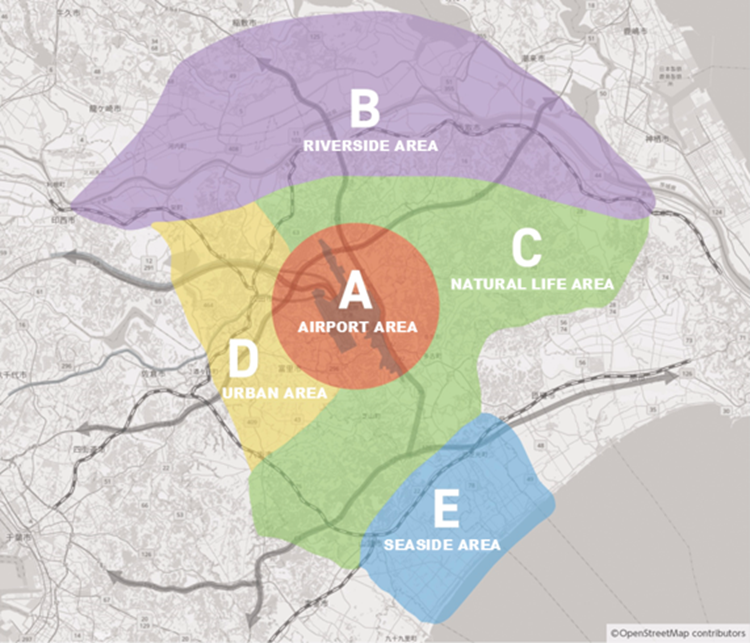
Under the SORATO NRT initiative, the goal is to create a world-leading airport city area by allocating functions across five distinct areas, encompassing not only areas adjacent to the airport but also the surrounding municipalities.
The Airport Area, located in close proximity to the airport, is expected to attract international industrial and logistics activities by leveraging its unique locational advantages. Key sectors anticipated to cluster in this area include the aerospace industry, advanced industries, life sciences, and research institutions. In the other areas—the Riverside Area, Natural Life Area, Urban Area, and Seaside Area—zoned layouts are being considered for industrial and living hubs, tourism and resort hubs, and economic exchange hubs, making the most of each area's unique characteristics.
In particular, proximity to the airport is a critical factor for industries that require rapid transportation and stringent quality control. Aerospace-related activities such as MRO services and small satellites, pharmaceuticals and biotechnology products in the life sciences sector, and precision instruments and semiconductors in the advanced manufacturing sector can benefit from a highly competitive business location through their close access to Narita International Airport and its extensive international logistics network.
The Five Areas Comprising SORATO NRT
Infrastructure and Institutional Support for Business Operations
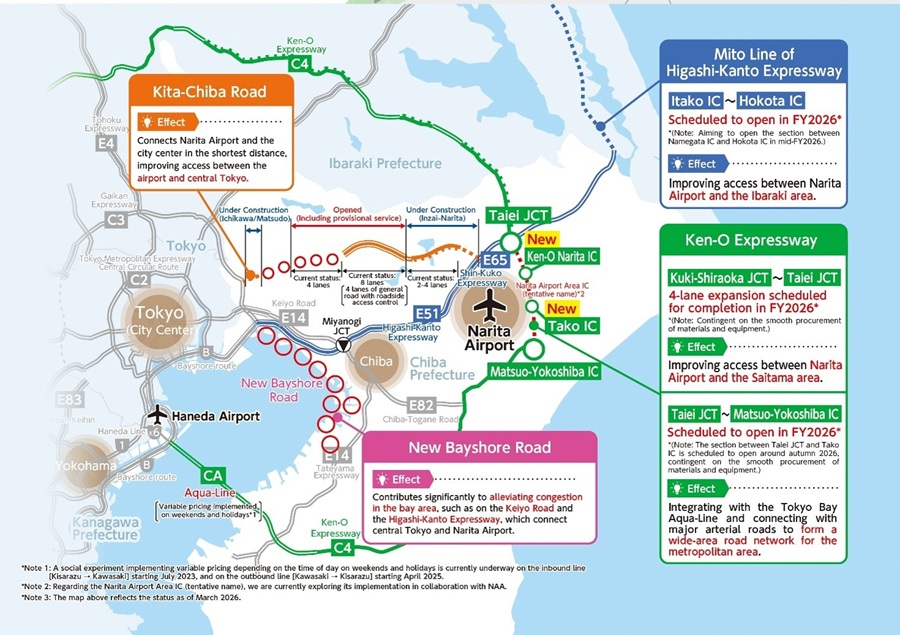
With regard to the transportation infrastructure, plans are in place to further strengthen the wide-area road network through the full opening of the Ken-O Expressway (Metropolitan Inter-City Expressway), the construction of new interchanges, and the extension of the Higashi-Kanto Expressway toward Ibaraki Prefecture, which will dramatically improve access to the Tokyo metropolitan area and the Northern Kanto region.
Furthermore, in the airport surrounding area, businesses can leverage a range of institutional support measures that encourage business investment and site selection. These include the framework of the National Strategic Special Zone covering the entirety of Chiba Prefecture, support programs under the Regional Future Investment Promotion Act, and subsidy programs offered by Chiba Prefecture and other local governments for companies establishing operations in the region. These programs also offer significant advantages for overseas companies considering investment in Japan, and are expected to help reduce the burden when establishing a business base in Japan and improve the overall investment environment.
SORATO Network
Hub for Serving the Japanese Market and Expanding Across Asia
The SORATO NRT Airport City Project, advancing alongside the expansion of Narita International Airport, represents a new urban development strategy that integrates industry, logistics, and residential functions around the airport as its core.
Moving forward, as airport accessibility improves and industrial clusters continue to develop, the region is expected to strengthen its position not only as a gateway for entering the Japanese market, but also as a vital hub supporting logistics and business expansion across Asia.
The combination of close proximity to the airport, enhanced transportation networks, and institutional support measures such as the National Strategic Special Zone framework is expected to accelerate the concentration of businesses across a wide range of sectors, including logistics, aerospace, advanced industries, life sciences, and research and development. Consequently, the area is likely to become an increasingly attractive business hub for domestic and international companies seeking to expand into the Japanese and broader Asian markets.
Other Spotlights
-
Creating a Global Business Hub Through "The NEW NARITA AIRPORT Project"
-
The Opening of BioLabs Tokyo: The Potential for Investment in Japan's Life Sciences Sector and Ecosystem Development (Part 1)
November 2026

-
TSUNAN SAKE BREWERY Explores Sustainable Partnership with Indonesian Startup Bell Living Lab
November 2026
Explore More
-
Why Japan
A world-class business environment, Japan provides fertile ground for innovation, and endless possibilities for business expansion. That’ s why global business leaders have chosen to invest here. Work with JETRO to map out a path to success and launch your business in the Japanese market.
-
Attractive Sectors
We introduce Japan's attractive sectors. Learn about each sector's general overview and trends, government initiatives, and alluring markets for foreign companies.

JETRO supports your business in Japan

We provide consistent one-stop service for establishing a base or expanding business in Japan. See the details of support services that JETRO provides when setting up business in Japan.
Contact Us
Investing in and collaborating with Japan
We will do our very best to support your business expansion into and within Japan as well as business collaboration with Japanese companies. Please feel free to contact us via the form below for any inquiries.
Inquiry FormJETRO Worldwide
Our network covers over 50 countries worldwide. You can contact us at one of our local offices near you for consultation.
Worldwide Offices


