





























Success Stories Positioning Japan at the Center of AI and Next-Generation Semiconductor Design: Tenstorrent's Growth Strategy
Led by legendary engineer Jim Keller, Tenstorrent is positioning Japan as the next major frontier for AI semiconductor design. The company aims to pioneer the "physical AI" era by integrating its open RISC-V technology with Japan's robust industrial foundations, including the automotive and robotics sectors. Tenstorrent is rapidly scaling its domestic operations through a strategic production partnership with Rapidus, while utilizing various resources such as JETRO's support to expand its engineering team. Their journey demonstrates how global innovators can successfully unlock Japan's immense potential and lead the next technological revolution.

- Establishment
- 2023/01
- Destination
- Tokyo・Kanto
- Digital & AI
- Semiconductors, Robotics, and Machinery
-
USA

Update : 2026/04
Watch Video
The "Legendary Engineer" Attracting Leading Global Talent
Japan's semiconductor and AI-related industries stand at a watershed moment. As a pillar of national strategy, the Japanese government is accelerating both the development of domestic hubs to handle next-generation semiconductor design and mass production, as well as the attraction of leading overseas firms. A case in point is Tenstorrent, a Canada-based semiconductor company specializing in design.
Tenstorrent, founded in 2016, is currently led by Jim Keller—a "legendary engineer" known for developing groundbreaking processors at Apple, AMD, Tesla, among others. Keller, an unconventional leader who insists on wearing T-shirts even at press conferences and VIP meetings, is recognized for prioritizing technical substance over formality. Top engineers from around the world continually gather at Tenstorrent to work under Keller, motivated by his vision to democratize access to the next generation of AI infrastructure.

Mamoru Nakano, President & CEO of Tenstorrent Japan
Tenstorrent's Japanese subsidiary was established in January 2023. The company has already announced its collaboration with Rapidus, which aims to achieve domestic production of cutting-edge semiconductors, and has been rapidly building up its design and production capabilities in the country. The driving force behind this acceleration is Tenstorrent's strong commitment to positioning Japan as its "next major frontier" after North America.
The push to enter Japan was proposed to headquarters by Mamoru Nakano, President & CEO of the Japanese subsidiary. Initially, the headquarters showed limited interest in the Japanese market. Nakano recalls, "Japan has the world's leading automakers and holds high market share in robotics and precision machinery. It still ranks among the top economies by GDP. Given this, not taking on such a major market seemed like a missed opportunity. And at the same time, it was frustrating to see Japan being perceived as no longer at the center of AI and next-generation semiconductors. I wanted to bridge that gap."
Japan faces challenges such as population decline and slowing economic growth. Even so, it retains a robust industrial foundation—spanning automotive, robotics, and precision machinery—with significant potential for renewed advancement when integrated with AI. Business opportunities are not confined to domestic population size; Japanese companies compete on the global stage, and when their strengths are combined with state-of-the-art semiconductor design, a credible pathway to renewed growth becomes clear. This is the scenario Nakano envisions. He developed a business plan demonstrating how Japan could emerge as a frontrunner in the coming "physical AI" era and successfully gained approval from global headquarters.

Jim Keller, CEO of Tenstorrent
Photo provided by Tenstorrent Japan
Nakano stresses that when considering entry into Japan, it is essential to have objective market analysis and a plan that provides quantified return projections commensurate with the investment. It was his evidence-backed pitch about Japan's core strengths that ultimately convinced headquarters.
An Open Strategy to Make Japan an AI Design Hub—and Cultivate Talent
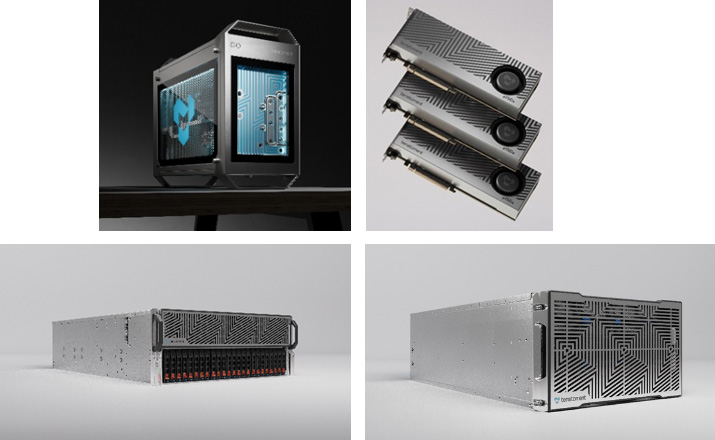
Tenstorrent's product lineup including AI accelerators
Photo provided by Tenstorrent Japan
Tenstorrent's distinguishing feature is its commitment to "not locking up" its technology. In contrast to major traditional chipmakers that rely on "black-box" strategies, Tenstorrent champions an open design philosophy based on the RISC-V standard, which anyone can use. Nakano says this flexibility is Japanese companies' greatest weapon.
"Japan's strength lies in its focus on quality and attention to detail. But direct adoption of generic overseas products often leads to mismatches in size, power consumption, and other specifications. Tenstorrent allows co-design starting from the intellectual property (design asset) level, so we can optimize to meet Japanese manufacturers' requirements. By combining Japan's manufacturing strength with our design capabilities, we can offer the best of both worlds."
The company is also working to train semiconductor design talent. Through an internship program in collaboration with the Ministry of Economy, Trade and Industry (METI), students and young engineers can directly access the latest design data from Jim Keller. Nakano says, "Jim declares, 'Technology becomes outdated in just a year or two—you don't need to hide it. Just let everyone see and learn. We'll keep moving further ahead.'" This open, on-the-job training (OJT) is the key to developing Japan's next generation of engineers on the fast track and forming the foundation for it to regain its position as a "country of design." The company plans to develop 200 design engineers by 2029 through OJT in the United States.
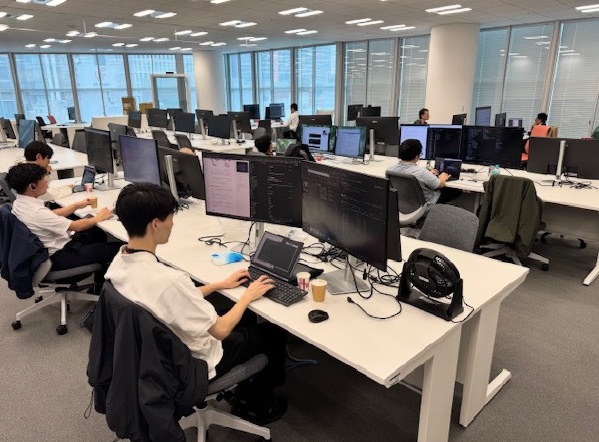
Tenstorrent's Tokyo office
Photo provided by Tenstorrent Japan
Three Pillars Driving Tenstorrent's Expansion in Japan
Tenstorrent is currently expanding its operations in Japan across three core pillars. First is the provision of systems for AI data centers; the company has already begun operating a data center in Osaka with a CSP (Cloud Solution Provider) partner and plans to expand into Tokyo as well. Second is the supply of IP, chips, and servers to manufacturers in the automotive, robotics, and precision machinery sectors, with several Japanese automakers already committed to adoption. Third is the development of domestic AI chips in collaboration with Japanese organizations. The company is already advancing an AI chip development project in collaboration with a domestic research organization. To further promote such development projects in Japan, it plans to increase the number of engineers at its domestic base by about 100. "The widespread adoption of domestic chips will bolster its national strength," Nakano says with conviction. "It is our mission to drive these initiatives forward."
The company is also intensifying its focus on the development of low-power CPUs for edge computing in Japan. These designs—optimized for battery-operated, high-performance applications, such as security cameras, agricultural machinery, and leisure mobility—share a natural synergy with the Japanese technical values of being "compact, energy-efficient, and high-performance."
JETRO's Assistance: A Catalyst for Success
Foreign companies often face barriers when entering Japan—from language and cultural differences to administrative procedures. When Tenstorrent first expanded, "no one in Japan knew us or understood what we did," says Nakano. At that time, the company had the opportunity to connect with JETRO, which supports the entry of foreign companies into Japan. Participating in networking events and seminars with Japanese companies allowed Tenstorrent to establish meaningful relationships with key stakeholders in the domestic market. "We had chances to introduce the company, and gradually business conversations started from those relationships," Nakano reflects. "The industry-specific data provided by JETRO was also instrumental in our rigorous analysis of Japan's technical landscape."
Today, Tenstorrent's ambition extends beyond major metropolitan areas such as, Tokyo and Osaka. The company sees immense potential in Sapporo and Chitose in Hokkaido Prefecture, which are rapidly emerging as a strategic center for next-generation semiconductors. Nakano envisions these areas evolving into "intellectual and industrial fusion hubs," akin to the ecosystems seen in Boston or Toronto. "Once Rapidus reaches the mass-production phase," Nakano notes, "there is a strong possibility that we will establish an office or a research laboratory in the region."
With the company's progress, Japan is poised to resume a leading role in semiconductor design. Keller calls on his workforce to "hire more Japanese engineers—they're excellent." With AI now essential across industries—automotive, robotics, smart cities, and AI data centers—Nakano emphasizes, "Japan has the reliability to see things through and the industrial potential for major returns." Tenstorrent's success is proof to global companies that Japan remains an open, attractive hub for innovation and investment.
Related Success Stories
Regional Information
Explore More
-

Success Stories
Success Stories are based on interviews conducted with foreign companies and foreign-affiliated companies that have successfully come into the Japanese market.
-

JETRO’s Support
We provide consistent one-stop service for establishing a base or expanding business in Japan.
-

Setting up Business
You can find information on overall and detailed steps, cost estimation, an overview of the laws, regulations and procedures related to setting up business, and more.
Contact Us
Investing in and collaborating with Japan
We will do our very best to support your business expansion into and within Japan as well as business collaboration with Japanese companies. Please feel free to contact us via the form below for any inquiries.
Inquiry FormJETRO Worldwide
Our network covers over 50 countries worldwide. You can contact us at one of our local offices near you for consultation.
Worldwide Offices