



























ChopValue: Turning Disposable Culture into a Circular Economy Opportunity
Canadian startup ChopValue is transforming massive chopstick waste into high-performance furniture and architectural materials in Japan. Establishing its first East Asian Microfactory in Kawasaki, the company successfully navigated complex regulations through strategic partnerships with JETRO and local governments. Explore ChopValue's journey, demonstrating how they align innovation with Japan's GX 2040 Vision and cultural landscape to build a scalable, sustainable circular economy business.
- Establishment
- 2024/07
- Destination
- Tokyo・Kanagawa・Kanto
- Sustainability & Energy
-
Canada

Update : 2026/04
Watch Video
(Interviewed in January 2026)
Every day in Japan, millions of disposable chopsticks are used only once and then thrown away—ChopValue sees this environmental issue as both a challenge and an opportunity to build a scalable circular economy business.
For this Canada-founded circular manufacturing company, Japan represents a strategic market where cultural practices, urban density, and strong environmental awareness converge. By transforming discarded chopsticks into high-performance products, including furniture and building materials, ChopValue has positioned itself at the intersection of sustainability, design, and manufacturing innovation.
Founded in Vancouver in 2016 by German wood engineer Dr. Felix Böck, ChopValue has, in less than a decade, grown into a global circular economy enterprise operating in ten countries. Its Japanese subsidiary began operations in Kawasaki City in 2025, marking a major step in the company's international expansion and its first manufacturing base in East Asia.
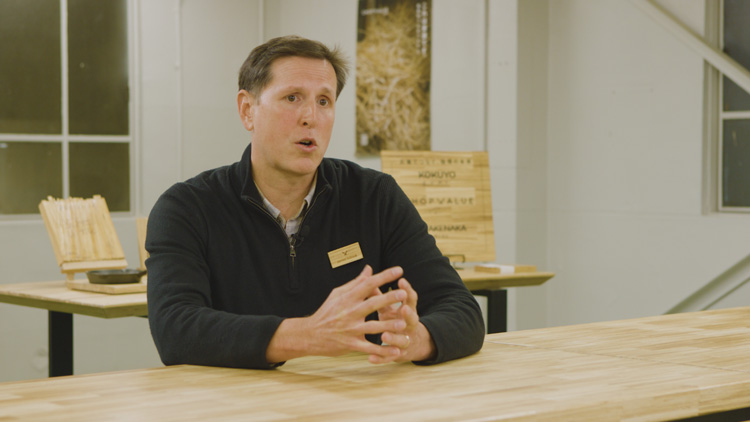
James Soback, Interim Japan Director of ChopValue
The move aligns with Japan's broader green-growth agenda. In 2025, the government adopted the Green Transformation (GX) 2040 Vision—a medium- to long-term national strategy to achieve decarbonization while promoting economic growth through the creation of new demand and markets.
"Chopstick Nation," a Core Strategy Destination
While disposable chopsticks are ubiquitous across East Asia, Japan stands out not only for scale but for cultural resonance. "In Japan, your first meal has a ceremonial pair of chopsticks for okuizome—a ritual meal for 100-day-old infants—and chopsticks even play a role in funeral rites. In other words, chopsticks are present from the very beginning of life to the very end."
Beyond culture, Japan's compact, densely populated cities are a natural fit for ChopValue, Soback says. "The density of the Japanese population makes it easy for our overall concept to work, from collection through to local distribution."
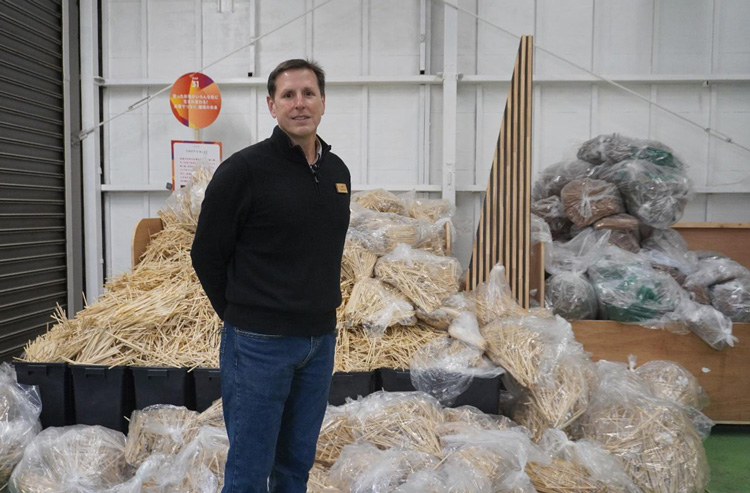
Soback standing in front of chopsticks collected from local businesses at the Microfactory in Kawasaki
Going National by Starting Local
ChopValue's long-term ambition in Japan is national in scope, but execution began with a single Microfactory. After an extensive search across the Tokyo–Yokohama corridor, the company selected Nakahara Ward in Kawasaki City as the site for its first Japanese facility.
"Our overall intention in Japan is to be nationwide. However, we have to start somewhere," Soback says. "The Nakahara Ward facility became available, and we immediately applied and were successful."
Kawasaki City, known for its thriving manufacturing industry, is pursuing a vision of becoming a sustainable, green-innovation city that harmonizes the environment and the economy. The city's efforts to realize a circular economy through the creation of environment-related businesses, combined with its focus on international cooperation, align perfectly with ChopValue's mission, making it the ideal location for the first Microfactory.
The facility is designed to process up to 25 million chopsticks per year, converting them into modular materials used for furniture, wall paneling, and architectural applications. The facility reflects ChopValue's Microfactory concept: compact, self-contained, and deeply embedded in the local community.
JETRO's Role: Access, Acceleration, and Trust
One of the biggest hurdles ChopValue faced in Japan was not technical, but regulatory—specifically, the question of how used chopsticks can be collected, and by whom.
"This business is built around collection, and right now disposable chopsticks in Japan are considered waste," Soback explains. "Waste law is generally controlled at the city (municipal) level."
To address the issue, ChopValue worked closely with the Japan External Trade Organization (JETRO), the Kawasaki City Government, and community partners to reframe chopsticks as a recyclable resource under a pilot research framework. "Like any startup, there will be challenges along the way," Soback explains. "The partnership that we've been able to develop with Kawasaki City has been amazing."
Patience, he adds, is essential. "You have to be prepared for the long game in Japan. You cannot expect things to move extremely quickly. But once it starts to move, it moves."
JETRO played a central role in ChopValue's market entry—both structurally and strategically.
The organization, Soback says, provided "really key introductions to potential business partners," including major Japanese firms such as KOKUYO, a stationery and furniture maker, and TAKENAKA CORPORATION, a construction company. JETRO also helped ChopValue find service providers that supported setup and compliance.
Soback also emphasizes that JETRO's global and domestic network was equally important. "We've worked with JETRO in Canada and Singapore. JETRO has so many different office locations, and they're able to hand that information across to their counterparts, so that way we can move quickly."
One particularly memorable introduction involved a meeting with an eighth-generation disposable-chopstick manufacturer in Yoshino, Nara Prefecture. "There's no way I would be able to have that meeting on my own," Soback recalls. "But with JETRO, we were able to open that door to have a successful conversation."
Partnerships Driving Scale
ChopValue's first Japanese partnership was with STORY, a community organization dedicated to fostering flexible work opportunities for mothers raising children that aligns closely with the company's grassroots philosophy. The organization has leveraged its established local network to introduce staff to ChopValue and support coordination between ChopValue and government agencies and partner businesses. "The STORY partnership has been immense," Soback notes. "Because it's really community-based, and this business is all about being hyper-local."
As ChopValue moves into its next growth phase, large B2B partnerships are enabling scale. "That's where partnerships with KOKUYO and TAKENAKA are critical, because then they can help us go to their clients at the same time," Soback adds. The collaborations allow ChopValue to integrate sustainability directly into offices, hotels, and construction projects—targeting enterprises seeking tangible, high-performance solutions rather than symbolic green initiatives.
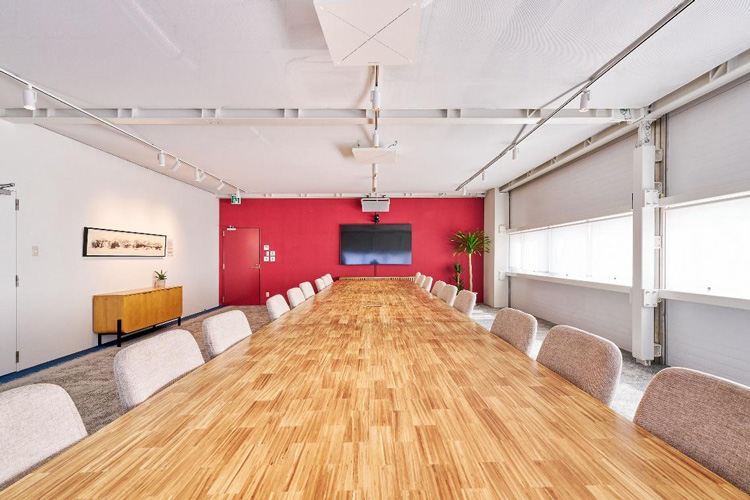
A custom conference table showcased at the Canada Pavilion at Expo 2025 Osaka, Kansai, Japan
Customer response in Japan has exceeded expectations. "Absolutely amazing," Soback says. Installations range from public spaces to high-profile projects such as Expo 2025 in Osaka, Kansai, where ChopValue provided furniture and wall paneling for the Canada Pavilion using more than one million recycled chopsticks.
"Yes, it is a sustainable material," Soback explains. "However, the key has to be the performance—the durability, the quality, the craftsmanship that goes into it."
Making Sustainability Tangible
Since opening in April 2025, the Microfactory in Kawasaki has recycled over 10,000 kilograms of material. But for ChopValue, impact is not measured solely in volume. "It's really about bringing sustainability and making it very tangible for the individual," Soback says. In practice, this focus on tangibility has also given rise to an educational dimension of the business.
This educational role has become an unexpected but meaningful part of the company's mission, with schoolchildren taking tours of the Microfactory. "Literally, in our factory, you can see it go from a chopstick through to furniture," he adds. "They're actually holding sustainability in their hands."
Japan's scale presents both opportunity and challenge. In the Kanto region alone, 27 million chopsticks are discarded every day. "A single Microfactory cannot process the total volume of chopsticks generated in Japan," Soback notes.
Looking ahead five years, ChopValue envisions establishing up to 100 Microfactories across Japan. A challenge with community-based businesses is that each new location is unique, but Soback hopes to apply the lessons learned in Kawasaki. "We have built a model with Kawasaki City. How do we replicate that without having to start from zero in another location?"
Soback's advice to other foreign entrepreneurs is clear and pragmatic.
"Having a great product doesn't mean you will be successful in Japan. Having great relationships, however, will open the door to success."
With strong partnerships, patient execution, and JETRO's continued support, ChopValue's Japanese journey illustrates how foreign companies can align innovation with Japan's regulatory, cultural, and environmental landscape—and turn local challenges into scalable opportunities.
Related Success Stories
Regional Information
Explore More
-
Success Stories
Success Stories are based on interviews conducted with foreign companies and foreign-affiliated companies that have successfully come into the Japanese market.
-
JETRO’s Support
We provide consistent one-stop service for establishing a base or expanding business in Japan.
-

Setting up Business
You can find information on overall and detailed steps, cost estimation, an overview of the laws, regulations and procedures related to setting up business, and more.
Contact Us
Investing in and collaborating with Japan
We will do our very best to support your business expansion into and within Japan as well as business collaboration with Japanese companies. Please feel free to contact us via the form below for any inquiries.
Inquiry FormJETRO Worldwide
Our network covers over 50 countries worldwide. You can contact us at one of our local offices near you for consultation.
Worldwide Offices