

























May 2023
Mie Prefecture: The Strategic Heart of Japan's Semiconductor Ecosystem
March 2026
Backed by strong policy support from the Japanese government and local authorities, Japan's semiconductor-related market is on an expansionary trend, and industrial clusters are taking shape across the country. Among them, Mie Prefecture—located near the center of the Japanese archipelago—stands out for its strong presence. According to statistics from the Ministry of Economy, Trade and Industry (METI) and the Ministry of Internal Affairs and Communications (MIC), Mie has ranked No. 1 nationwide for 20 consecutive years in shipment value of electronic components, devices, and electronic circuits (including semiconductors).
Within the prefecture, three major semiconductor manufacturers—Kioxia, SanDisk, and United Semiconductor Japan (USJC)—have operations. A cluster of roughly 90 to 100 companies has formed, including related businesses such as semiconductor equipment makers, materials suppliers, and staffing firms. The flash memory plant in Yokkaichi City jointly operated by Kioxia and SanDisk is one of the largest in the world, underpinning production of memory whose demand is rapidly expanding in the AI era. Mie Prefecture has become one of the most important hubs in the global semiconductor supply chain.
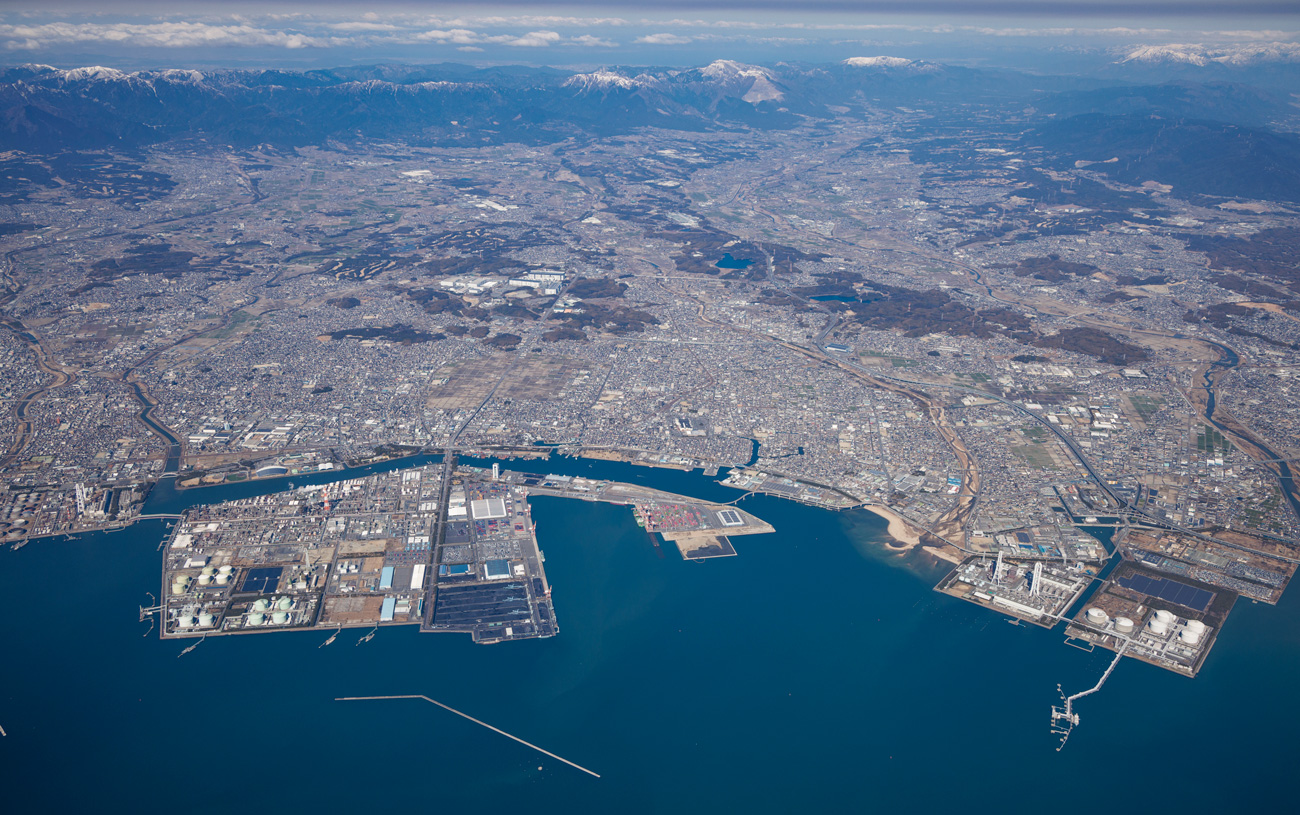
Aerial view of Yokkaichi City, Mie Prefecture, where semiconductor-related companies are clustered.
Provided by: Yokkaichi Port Authority
A Legacy of Manufacturing: Resources and Infrastructure
Mie has long been a manufacturing powerhouse, dating back to the textile industry of the Meiji era. It is rich in water resources—rivers and groundwater—essential for semiconductor fabrication. In addition, large-scale power substations and transmission networks provide stable electricity supplies to companies in the prefecture. While many industrial complexes and industrial parks were developed starting in the 1950s, the amount of industrial land available for corporate use has been decreasing in recent years. Consequently, plans are underway within the prefecture to develop an additional 300 hectares of land.
Another strength for Mie is its proximity to the Tokai and Kansai regions—major domestic consumption areas where parts and materials manufacturers are concentrated. It is connected by expressways to Tokyo, Nagoya, and Osaka, and offers easy access to two major international airports in the Chubu and Kansai regions—an especially attractive feature for logistics and supply chain development. Further improvements in convenience are expected with the Linear Chuo Shinkansen, which is slated to begin operations in the 2030s.
Driving Innovation in the Age of AI and EV
With the spread of AI and electric vehicles (EVs), semiconductors are becoming increasingly important. In particular, the explosive evolution of generative AI has dramatically boosted demand for high-bandwidth memory (HBM) for data centers and advanced logic semiconductors for sophisticated computation. Furthermore, the number of semiconductors installed in a single EV is said to be several times that of a conventional gasoline-powered vehicle.
Positioning the semiconductor-related industry as a core industry that will drive sustainable regional growth, Mie Prefecture is encouraging further entry by foreign companies. Mitsunori Nagai, Assistant Director of the Prefecture's Industrial Investment Promotion Division, explains: "We expect overseas companies to generate innovation with initiatives and technologies that have not existed in Japan until now. We believe this will serve as a stimulus that leads to stronger regional economic competitiveness and the creation of new industries."
Extensive Support for Foreign Investment
With this thinking, in 2013 the prefecture launched a program under which it subsidizes 20% of the depreciable assets invested when foreign companies establish production sites in the prefecture. In addition, in 2016, to lower the hurdle of initial investment, it also created a subsidy program covering half the rent for the first three years after opening an office. Moreover, it established a one-stop service desk for business attraction that provides end-to-end support—from site selection through various applications for factory construction and follow-up after operations begin—and it has assigned specialized staff capable of handling inquiries in English. Working in cooperation with JETRO, which collaborates on "promoting the attraction of foreign companies," as well as with municipalities within the prefecture, Mie is actively pushing forward efforts to attract investment. With the goals of creating new jobs, expanding business opportunities, and strengthening the overall competitiveness of the region, it is placing particular emphasis on supporting collaboration and matchmaking between incoming companies and local firms.
When foreign companies enter Japan, complicated administrative procedures and a complex tax system can become hurdles that may discourage investment. In the semiconductor-related sector in particular, where the pace of technological innovation is rapid, swift management decisions and prompt execution of measures are required. Nagai explains: "We have assigned technical engineers within the Industrial Investment Promotion Division so we can respond immediately when there are inquiries about factory sites. The prefecture supports companies by helping procedures move forward as quickly and smoothly as possible, shortening the time required for permits and approvals and reducing costs, within the bounds of the law."
"It's the People"
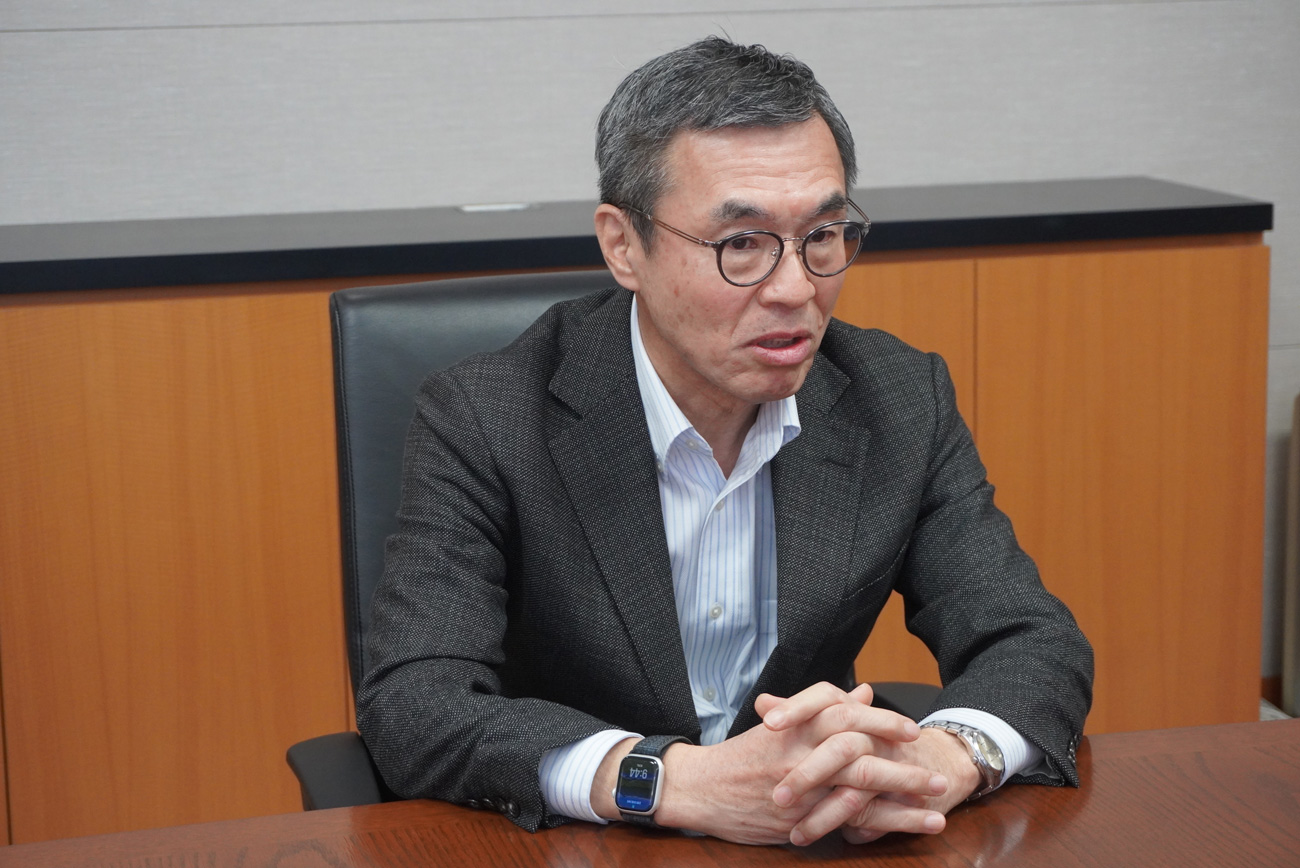
Tetsuro Hori, President of JSR
JSR is a materials manufacturer with world-leading market share in microfabrication materials such as photoresists (photosensitive materials), which are essential for forming semiconductor circuits. It supplies many products to Asia and the United States and is a global company with its overseas sites. Even so, its Yokkaichi plant in Mie Prefecture serves as the company's "mother plant" for both R&D and production.
JSR President Tetsuro Hori explains the strategic significance of maintaining bases in Japan: "Including suppliers, Japan's technological level is high." He continues: "People say it's digital and high-tech, but in the materials field, it's also a world of craftsmanship. For example, with photoresists, the key is the technology to prepare a uniform solution—an area Japan excels in. High quality and meticulousness are among Japan's major strengths."
At JSR's Yokkaichi plant, some employees are involved in semiconductor materials manufacturing as second-generation workers. The pool of excellent semiconductor talent accumulated in the prefecture over more than 50 years, Hori says, is "irreplaceable." The company plans to actively expand collaboration with equipment makers such as Applied Materials and Lam Research. With photoresists, CMP slurry (a semiconductor polishing material), and advanced electronic materials for back-end processes as its pillars, it will continue growing in global markets, but the core of its R&D and manufacturing base will remain in Yokkaichi. Hori states unequivocally: "We will not leave Mie Prefecture."
Securing the Future: Investing in Human Resource Development
Efforts have also begun to further cultivate semiconductor talent that is sought by companies worldwide, and to pass it on to the next generation. In Yokkaichi City, a private skills center opened in 2022, where people can learn operation and maintenance techniques by using actual semiconductor manufacturing equipment.
In addition, in 2023, the prefecture established the "Mie Semiconductor Network" together with semiconductor-related companies, municipalities, and Mie University. Through initiatives such as companies' sending lecturers to educational settings, factory tours, and internships, the public, private, and academic sectors are working together on human resource development. In 2025, Mie University and Toba National College of Maritime Technology each established specialized courses in semiconductors and digital technologies. Nagai explains: "To increase the overall pool of STEM talent, it is important to spark interest in semiconductors from a young age." He says that they conduct outreach classes and hands-on sessions at elementary and junior high schools. The network has also produced semiconductor PR videos that can be used in classes.
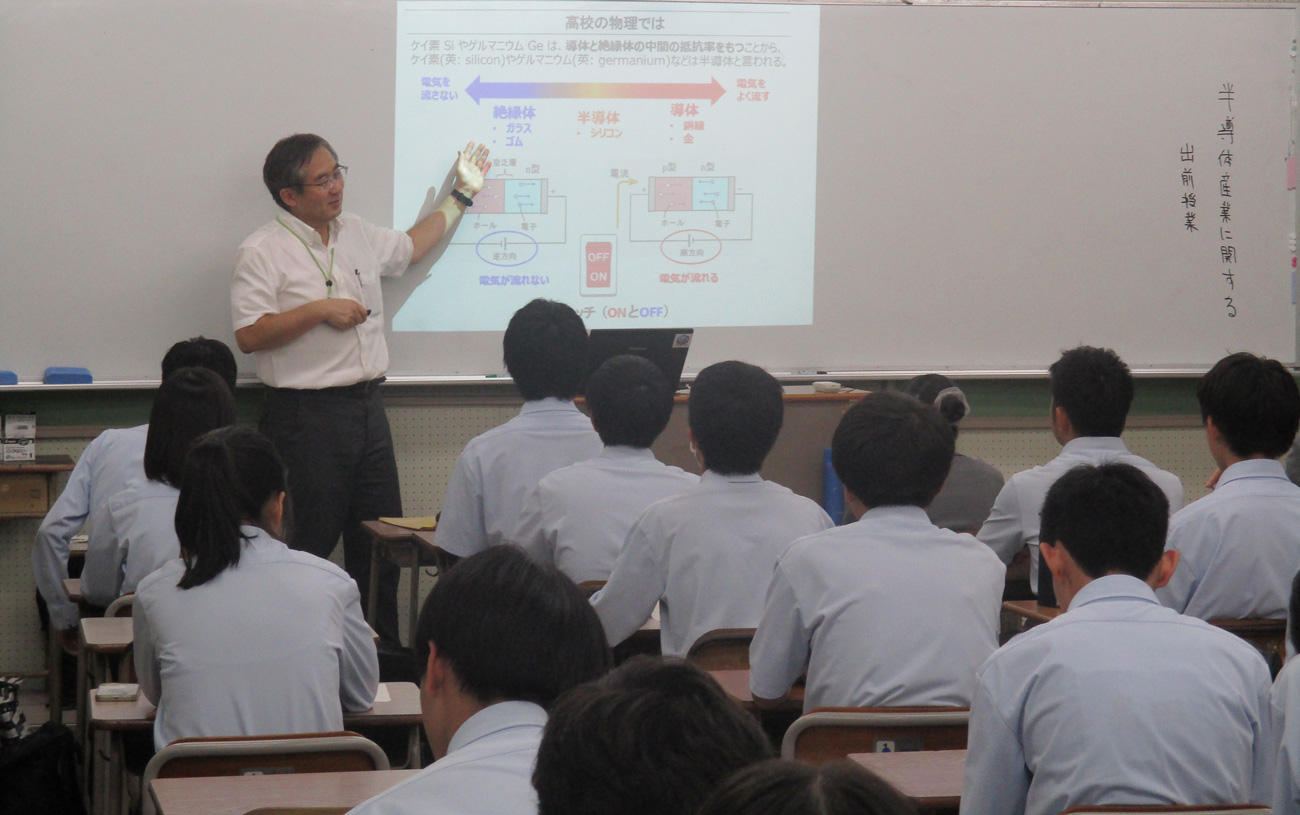
Professor Hideto Miyake of Mie University (Electronic and Information Engineering) delivers an outreach lecture on semiconductors at a high school
Provided by: Mie Prefectural Government
Geographical advantages, abundant resources, advanced technology, and a highly skilled talent pool to carry the industry forward—Mie Prefecture embodies an ideal form of Japan's renewed semiconductor ecosystem. Government investment support and bold regulatory easing that position semiconductors as a key strategic sector, along with generous measures to attract foreign businesses, are serving as powerful engines to support entry into Japan's market. Across the country, clusters are forming. Kumamoto is home to the world's largest foundry, TSMC, which has entered the region and is now building a second fab. Hiroshima is a key location where U.S. company Micron Technology is making significant investments to strengthen its role as an advanced memory production base. In Hokkaido, Rapidus is moving forward with a major project aimed at domestic production of next-generation semiconductors. In the Tohoku region, power semiconductor and equipment manufacturers are concentrated. For companies seeking geopolitical stability and supply chain resilience, and for companies looking for a stage to accelerate innovation, Japan is evolving into one of the most reliable strategic hubs.


Learn More


Contact Us
Investing in and collaborating with Japan
We will do our very best to support your business expansion into and within Japan as well as business collaboration with Japanese companies. Please feel free to contact us via the form below for any inquiries.
Inquiry FormJETRO Worldwide
Our network covers over 50 countries worldwide. You can contact us at one of our local offices near you for consultation.
Worldwide Offices