





JETRO Global Connection -Accelerate Innovation with Japan-
Interview
From Techstars Tokyo to Hustle Fund’s First Investment in a Japanese Startup: How O-ID Connects Japan’s Manufacturing Strength with Global Capital
(Japan)
November 2026
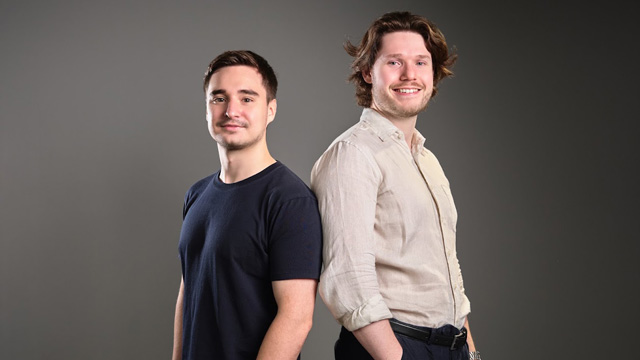
When Stian Jakobsen , Co-Founder and CEO, and Simon Gormuzov, Co-Founder and CTO, joined Techstars Tokyo in the summer of 2025, they had an ambitious idea: to build a humanoid robot in Japan that factories could use, repair, and keep running.
Just over a year later, their company, O-ID, announced a US$1.2 million pre-seed funding round, equivalent to approximately JPY 200 million. The round brought together TAWANI Ventures, Hustle Fund, Techstars, and angel investors from Japan and overseas. Most notably, it marked Hustle Fund’s first investment in a Japanese startup.
For O-ID, Techstars Tokyo opened the door to a series of conversations, introductions, and relationships that would shape the company’s journey. Mentors shared their experience and networks in the spirit of Techstars’ “Give First” philosophy, while Stian and Simon acted quickly on their advice and introductions. The experience helped them sharpen their business, expand their global network, and build the commercial traction that would later support their subsequent fundraising.
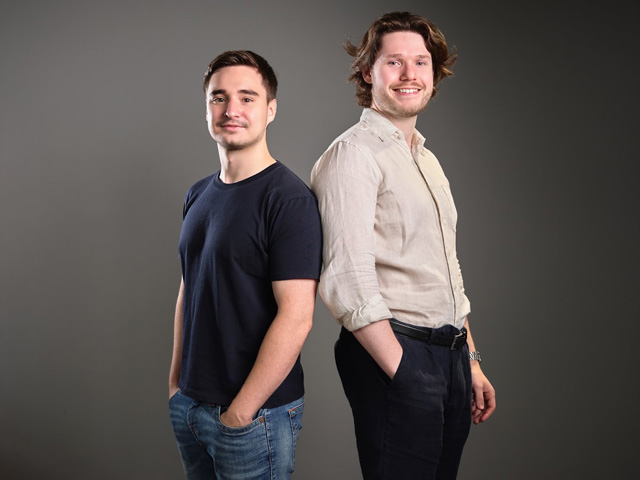
Stian and Simon (Photo provided by O-ID)
Building Humanoid Robots in Japan
Stian and Simon founded O-ID in Tokyo in 2025 after meeting at Waseda University. Originally from Norway, Stian previously worked in cyber defense and the protection of critical infrastructure. Simon, who grew up in the Netherlands, trained as a mechanical engineer and gained experience in industrial automation and robotics, including at FANUC and Tokyo Robotics.
Their different professional backgrounds led them to a shared conclusion: if robots are to become an essential infrastructure for society and industry, they must be secure, reliable, easy to manufacture, and simple to repair.
Many conventional industrial robots require factories to redesign production lines around them. General-purpose humanoid robots offer greater flexibility, but when a single component fails, the entire machine can be unavailable for an extended period.
O-ID is taking a different approach. Its humanoid robot is designed as a fully modular platform, allowing individual components to be removed and replaced on site without sending the entire unit back to the manufacturer.
“If one part breaks, we do not want the customer to have to send the entire robot back to us,” Simon said. “Our goal is to make it possible for someone on site to replace the module in about five minutes and get the robot running again.”
The robot can also be equipped with different hands, grippers, sensors, and specialized tools depending on the task it needs to perform. This flexibility is particularly useful in environments such as automotive production, logistics, agriculture, and other environments where continuous operation is critical.
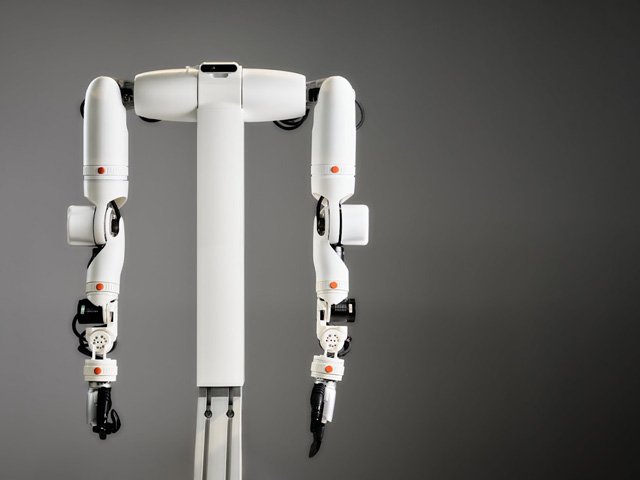
First modular prototype (Photo provided by O-ID)
Techstars Tokyo: Turning Mentorship into Momentum
A major turning point came when O-ID joined Techstars Tokyo 2025, powered by JETRO and Mitsui Fudosan, and in cooperation with the Cabinet Office, the Ministry of Economy, Trade and Industry, and the Tokyo Metropolitan Government.
O-ID was one of 12 companies selected from applicants across more than 120 countries and regions, with an acceptance rate of less than 1%. Beginning in August 2025, the founders leveraged Techstars’ vast global mentor network to test and refine their business model, improve their pitch, and clarify how their modular architecture addressed concrete customer needs. The founders worked closely with their lead mentor, Tom Moss, Techstars Tokyo EIR, serial entrepreneur and former COO and CEO APAC at Skydio, and Barry O’Neill, Partner at Value Create, also EIR.
Their involvement went beyond periodic mentoring sessions. The EIRs and mentors challenged the founders’ assumptions, offered candid feedback, drew on their own experience, and opened networks that could help move the company forward. With Techstars’ “Give First” philosophy, they contributed knowledge, time, and connections without expecting an immediate return.
Stian and Simon made active use of that support. They acted on advice, followed up on introductions, adjusted their strategy, and returned with evidence of progress. Through these repeated interactions, the founders sharpened both their business model and the way they communicated the value of their technology to customers and investors. At the same time, O-ID was building commercial momentum. The company formed a partnership with Tamachi Industries and is in discussions with Japanese manufacturers about paid proof-of-concept projects.
“Techstars Tokyo challenged us to rethink every assumption about our business through constant feedback from mentors and industry experts, while dramatically expanding our global network of investors. Those insights and introductions directly contributed to raising our pre-seed and played a major role in getting O-ID to where we are today,” Stian said.
By the time the program concluded, O-ID had a clearer business proposition, growing commercial traction, and a broader global network. JETRO's next step was to connect the founders with a new community of early-stage investors.
From Camp Hustle to Hustle Fund’s First Japan Investment
JETRO continued supporting O-ID after Techstars Tokyo. Through its startup scouting and investor outreach, JETRO developed relationships with Hustle Fund, a U.S. venture capital firm focused on early-stage startups.
In May 2026, JETRO worked with Hustle Fund to bring three companies from Techstars Tokyo, including O-ID, to join Camp Hustle in Saratoga, California. The three-day immersive event for investors brought together more than 250 angel investors, venture capitalists, emerging fund managers, LPs, and family offices. O-ID participated in the event’s Startup Showcase, which became an opportunity to spend time with investors and build strong connections.
After Camp Hustle, Stian and Simon remained in contact with Hustle Fund. They explained why modularity mattered in industrial environments, how their robots could be manufactured in Japan, and why labor shortages were increasing the need for reliable automation. They answered questions, shared evidence of progress, and continued the conversation as the company developed. Several months later, Hustle Fund invested in O-ID’s pre-seed round—its first investment in a Japanese startup. The milestone was significant not only for O-ID, but also for the connection between Hustle Fund and Japan’s startup ecosystem.
“Japan's factories are running out of people. The workers on the line are getting older, and there aren't enough younger ones coming in behind them. That's a huge opening for robots, but only if a factory can keep them running. Simon and Stian built O-ID so anyone can swap out a joint in about five minutes. When we met them, it was clear they understood the factory floor, and that's why we invested,” Shiyan Koh, Co-founder and General Partner of Hustle Fund said.
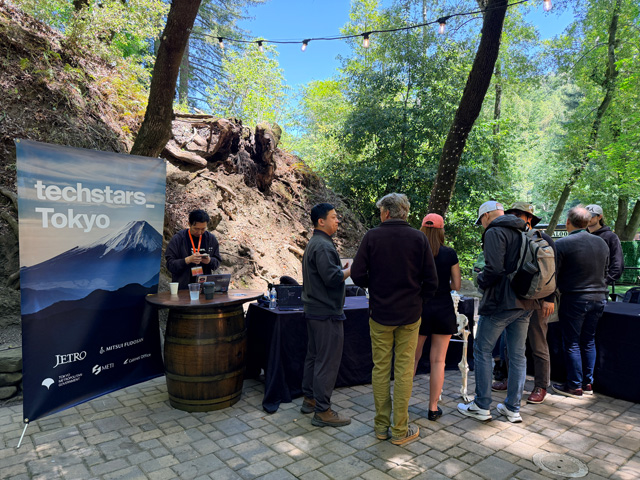
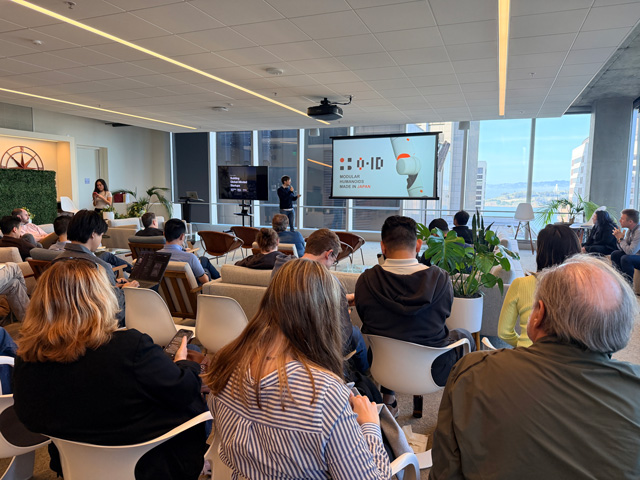
(a)O-ID and Techstars Tokyo companies showcasing at Camp Hustle (b)Simon pitching at JETRO – Techstars Tokyo joint event in San Francisco (taken by JETRO)
From Prototype to Production
O-ID will use the new funding to move its humanoid robot from prototype toward production and deployment on Japanese factory floors. Its initial focus is automotive manufacturing and logistics, with the company now working with Japanese manufacturers and component suppliers to establish a domestic production base.
One example is its work with Sumitomo Electric Industries, Ltd. O-ID has signed a letter of intent with the company to explore the potential application of Sumitomo Electric’s technologies to wire harnesses for humanoid robots. While still at an exploratory stage, the collaboration reflects O-ID’s broader strategy of combining its robotics platform with the capabilities of Japan’s established manufacturing ecosystem.
The company’s ambition extends beyond a single robot. O-ID aims to build a secure and resilient humanoid robotics supply chain in Japan, drawing on the country’s strengths in precision manufacturing, automotive components, and mechatronics.
“We believe Japan has the capabilities needed to become a global manufacturing base for humanoid robots,” Stian said. “By combining O-ID’s modular technology with Japan’s automotive supply chain and manufacturing expertise, we want to build our robots here and bring them from Japan to the world.”
With new capital and a growing network of manufacturing partners, O-ID’s next challenge is to turn those connections into modular humanoid robots operating on factory floors in Japan and, eventually, around the world.
Stian Jakobsen, Co-Founder and CEO
Stian Jakobsen is Co-Founder and CEO of O-ID. Originally from Norway, he previously worked in cyber defense at Norwegian Health CERT and holds a master’s degree in Information Security from NTNU. He co-founded O-ID after meeting Simon Gormuzov at Waseda University.

Simon Gormuzov, Co-Founder and CTO
Simon Gormuzov is Co-Founder and CTO of O-ID, leading development of its modular humanoid platform. Raised in the Netherlands, he has experience at FANUC Europe and Tokyo Robotics and holds a master’s degree in Intelligent Robotics from Waseda University’s Sugano Lab.

- Report by:
- Arisa Sonoda, Startup Support Division, JETRO

-
From Techstars Tokyo to Hustle Fund’s First Investment in a Japanese Startup: How O-ID Connects Japan’s Manufacturing Strength with Global Capital

November 2026
-
From Japan to Spain: Eco-Pork Brings AI to the Swine Industry

July 2026
-
How NeuralX is Building the Future of AI with Artificial Life Simulation

June 2026
-
US<>Japan VC Playbook: Bridging U.S. and Japanese Startup Ecosystems

February 2026
-
Overview of Japanese Startup Investment for US Venture Capitalists

May 2025
-
TBM, a Japanese Unicorn, is taking its environmentally conscious materials and solutions global

April 2025
-
Algal Bio’s Plan to Scale-up Microalgae Solutions for Food, Health, Climate, and more

March 2025
-
From Complexity to Clarity: How Veritus Helps Professors and Research Labs Innovate 5X Faster

February 2025


